I’ve put together a document detailing a bit of my perspective on this EIP here: dDocs | Privacy-enhancing Alternative to Google Docs
In short, I lean away from seeing this EIP implemented as is.
I’ve put together a document detailing a bit of my perspective on this EIP here: dDocs | Privacy-enhancing Alternative to Google Docs
In short, I lean away from seeing this EIP implemented as is.
You say that there’s been multiple surveys of solo stakers on this EIP. And that those surveys reject the EIP.
I’m a solo staker. I’ve not been surveyed. Can you identify the multiple surveys to which you refer in your post?
I’m a solo staker and a member of the ethstaker community. I support this EIP.
The most important vote isn’t in this thread, and it never is.
Every group in your tally has a business to defend. That’s why they’re here. The investor has none — he doesn’t post, doesn’t answer surveys, doesn’t organise. He votes by divesting. Voice for whoever has a business, exit for whoever only has capital, and exit never appears in a poll. It appears in the price, years later.
I’ll say plainly which side I’m arguing from: I’m here for the investor. I run a fund with ETH exposure, so I have every reason to show up — which is exactly the point. The party that pays for these decisions is the one party with no reason to be in the room.
4844 is the case study. Researchers backed it, L2s got cheap data, users got cheap transactions, the ecosystem got its scaling story. It looked unanimous because nobody in the room was paying. The bill went to L1 fee revenue — your “can’t measure” row. The rational response for an investor was to divest, and that is what happened. I opposed it at the time.
Now the same question is being asked again. 4844 removed the revenue that would have paid for security out of activity. 8363 removes the issuance that was paying for it instead. What’s left is patronage — grants, donations, nonprofits keeping client teams alive. That’s the Linux model, and a Linux model is one where the rational position for an investor is no position.
And the Foundation looks entirely comfortable taking us there. Teams spun out, public goods funded by donation, sponsors in place of revenue. That isn’t a constraint anyone imposed on it. It’s a strategy, and it should be argued for as one rather than arrived at through two separate technical decisions that nobody costed together.
So the question isn’t who supports this. It’s what it predicts. Mine: the ratio walks toward the threshold instead of settling below it, solo-staker share falls, ETH lending rates compress toward zero while stablecoin rates don’t. Wrong on those and I’ll say so. 4844 shipped with confident second-order predictions too, and nobody went back to check them.
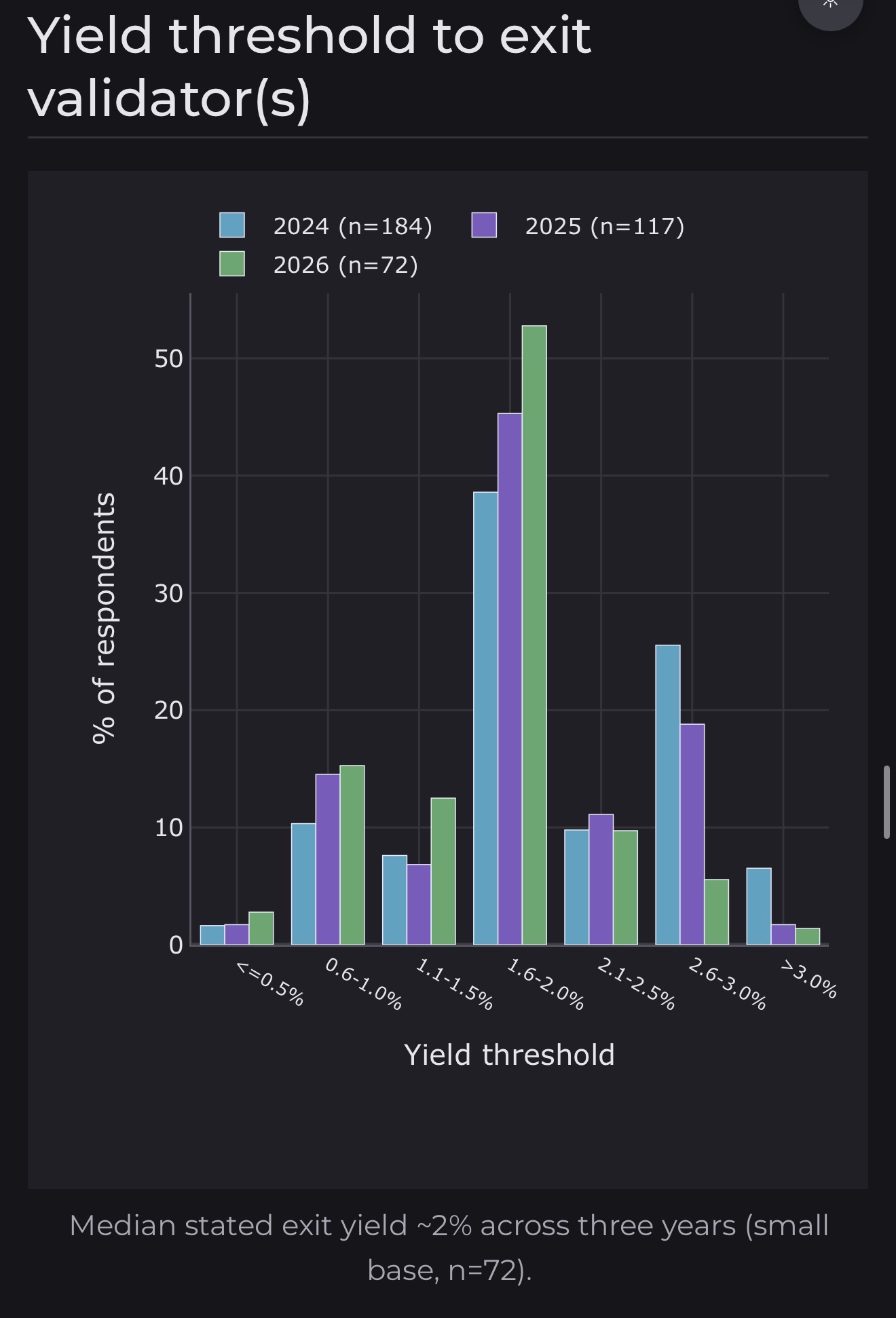
2% yield threshold to exit was consistent around 3 years of solo stakers surveys and the share of ones to leave below keeps growing YoY.
Obviously this proposal plans to reduce yield to 0% or far below 2%.
It will be foolish to say that yes solo stakers agree with this proposal and yes they will exit. Something here doesn’t match
Wanted to address the notion that because the highest marginal costs are on leverged stakers at the moment they will be the most impacted category. On first glance this seems correct: if their ETH borrow cost is slightly under 2%, then APR going to 1.5% will let them uncompetitive, right? I don’t think it’s so simple.
The reality of situation is
Your previous post states that solo stakers were surveyed on EIP 8363, and “rejected it.” But the ethstaker survey you cite is not about 8363. And it’s a very, very, very long chain of causation to say that based on the response to a yield question in the ethstaker survey, that solo stakers have “rejected” 8363.
true that the data we have is limited, but its shows a point vs counter argument “trust me, bro”
Not accepting a “trust me, bro” argument is exactly the point. Your original post here says there were “multiple surveys” of solo stakers that “rejected” EIP 8363. But that’s just not true.
Please bare with me, I’m going to zoom out and look at the core philosophy that should govern the network itself.
Ethereum is a consensus network, not a social contract or a welfare system. Its primary directive is self-preservation, technical efficiency, and security. Ethereum’s consensus and monetary integrity must never be held hostage by the financial derivatives built on top of it, nor by the divergent economic interests of different validator cohorts.
Stagnant Capital
Having too much ETH in the consensus layer is fundamentally unhealthy for the broader Ethereum economy. When a vast majority of the native asset is locked in staking, monetary momentum stagnates. While LSTs attempt to solve this illiquidity, they do so by introducing systemic risks—specifically recursive leverage loops and money substitution. A thriving layer-1 economy requires active circulating capital, not a passive network where the native asset is parked in consensus merely to secure a protocol that is already safe.
Validator cohorts - Kicking the Can Down the Road
Large scale holders and institutional custodians (ETFs, Staking Providers, exchanges, pools) operate under completely different economic rules than individuals. They have near-zero marginal costs and non-yield incentives (such as customer retention or regulatory offerings) that will compel them to keep staking even if yield is squeezed to 0.1% or lower. As someone suggested already, 0.01% is still better than 0%.
We already saw this play out with EIP-7514. There was a hope that limiting the queue would curb staking demand, but that assumption was incorrect—it merely created a physical backlog without dampening the market’s underlying appetite.
To be frank, we cannot solve this issue without making some hard decisions down the road, its been 3+ years this is top of mind and a major discussion point. But Ethereum’s greatest strength is its ability to adapt slowly and iteratively based on community direction.
So the question is; is EIP-8363 a healthy step in the right direction. It doesn’t break the security model, but it successfully moves the network into a state defensive adjustment.
There is a direct analogy here with regards to your body : For a body to stay alive, blood must flow freely through its veins—this is capital velocity. To defend itself, the body coagulates blood into solid clots to heal wounds—this is staking. But if too much blood clots, you get thrombosis, circulation stops, and the host dies.
In the Motivation section, the proposal claims:
Under this proposal increasing size is not rewarded, and this applies soonest for the largest operators
This is objectively false, as this counter example shows:
The proposal may cause total issuance to decline as the global staking ratio increases. However, that does not imply that an SSP is no longer rewarded for capturing additional delegated stake in a market with competition. The EIP’s “The effect on large operators” section presents the special case of “staker staking its own ETH” without acknowledging this additional assumption and completely ignoring everything else. Talking about an effect only present for a hyptothetical entity owning and staking in the order 15% of total ETH supply and completely ignoring the SSPs we are seeing in reality has no practical value and is very misleading.
Therefore, I am asking the authors to:
A few things I found interesting about the survey (I admit to not completing mine this year). While there were 528 survey responses overall, only 72 (13.6%) answered this particular question, down from about 18% in 2024. What does it tell us when 14% of the people that completed the survey opined on this question?
Another thing that I see is that the share of those that would accept lower yields before exiting is increasing, as the yield has gone down. 19.5% would accept less than 1.5% in 2024, compared with 30.6% in 2026. To me at least, this implies yield acceptance may be somewhat elastic given conditions. Alternatively - considering the small number that answered at all - maybe it’s just not that big a factor in deciding to stake / continue staking.
On the “supply inflation affecting staking decision” question, 70% answered, and only 38.5% of them said they considered it (27% of all survey respondents).
Of the 251 written comments, 50 were regarding issuance. About 16 (3% of all respondents) argued cutting issuance hurt solo stakers, 10 (1.9% of all respondents) seemed to support MVI.
To me at least, it’s very difficult to say this survey is a strong signal on the issue.
Thank you for the comment and welcome to this forum!
You present a fair and common framing regarding the part of DeFi granting intermediated access to staking yield. Your ask regarding the “DeFi impact analysis” has a direct answer: it does not exist yet and producing it would require the involvement of the different venues’ risk teams (Aave, Lido, Ether.fi, others willing) so we end up with a cascade model for the LST and lending stack that is covering the transition window and not just the steady state. From our perspective, such analysis could argue for different curve shaping and transition period but could not in anyway prevail on the security reasons for this EIP.
I want to slightly push back on the quote bellow and then address your questions in order.
The staking rate DeFi prices off is not free income. Issuance buys a real service , ie. security, the question is its price. Today it is paid by diluting every unstaked holder: roughly 1.05M ETH a year on a 122M supply, about 0.86% annual dilution, rising toward ~1.07% at 60M staked. Yield earned downstream of that issuance is the transfer passing through, unstaked holders to staked ones, minus fees. How it nets out for DeFi depends on the raw-vs-staked split of collateral and treasuries, a number the involved DeFi venues have and we do not. Both curves, the current one and the one we propose, are administered schedules but the difference between them is the bill for the ETH holders (stakers included). The tapered’s net issuance peaks near 0.5% of supply around a 20% staking ratio and reaches zero at 50%, leaving the residual rate to the marginal staker’s premium. The current curve subsidizes entry at every ratio, never below a ~1.5% all-in floor. In that context, the honest distinction between the current and proposed curve could be “Bounded versus Unbounded subsidy”.
The staking yield has fallen from 20% at genesis to roughly 5% around the Merge to under 3% today. That decline was endogenous, it was steming from competitive entry under a published formula anyone could evaluate. This EIP is an announced change to the curve itself with a rather long transition period to smooth things out. What I can see from the past diminutions of the yield is that positions built on the rate’s level have adjusted repeatedly, and I admit this hasn’t been painlessly. For example in June 2022, stETH was at a 7% discount while Celsius and 3AC unwound a leveraged staking stack. The withdrawals-enabled LSTs are different collateral now and the transition is progressive. As stated above, a cascade model would cover the transition window and better gauge the impact for the involved venues and, as mentioned in my previous post replying to @EthWarrior, we are willing to collaborate.
EIP-8363 is the first change to the staking-rate curve since beacon genesis, and it is a change anyone can position for (a lot) in advance thanks to its transition period. I do not think at all our approach falls into “changing the rates without notice”, it is quite the countrary actually.
I am not aware of anybody with a defensible estimate (including us) to pinpoint where it’s most likely to land. It turns on whether the staking/borrow spread compresses proportionally or holds in absolute terms. This is the unknown, and it matters: at 12x, a loop on a 40bp absolute spread returns about 6.9% on equity at a 2.5% staking rate and 5.6% at 1.2%, a loss of roughly a fifth; if the spread compresses proportionally, the levered return roughly halves. A cascade model would help for this matter. We don’t know either what other yield options may appear in the market as staking yield becomes less of the de facto best yield for risk out there.
Nerverthelesss the mechanical claim is narrower than “borrow rates follow the yield down”. The looping cannot durably pay more than the LST yield it captures, so it caps the loop-driven component of borrow demand, not the borrow rate, which shorts, basis and event-driven flows have pushed far above staking yield (Aave froze ETH borrowing pre-Merge over exactly that if I remember correctly). ETH borrow demand comes from mostly from two sides, on the one hand for shorting ETH Loopers (borrow ETH to sell it, betting it goes down or hedging), on the other hand for looping (borrow ETH to stake it and pocket the spread between staking yield and borrow cost). The latter are yield buyers. They may very well have no opinion on ETH’s price direction; they’re long ETH the whole way through and borrowing purely to lever the staking spread. Some other actors may borrow ETH cheaply, hold stablecoins yielding 4 to 5%, i.e. use ETH as the funding leg of someone else’s trade and one of the expected consequences of EIP-8363 is a likely cheaper ETH funding leg.
The carry offset shrinks and those leveraged positions get more expensive to hold. The leveraged versions of the trade it is, mechanically, a levered pass-through of the issuance subsidy. The yield offsetting those loans is mostly newly issued ETH, so the trade was borrowing against a subsidy. The more leverage, the more subsidy per dollar of pledge collateral. What EIP-8363 removes is a portion of the subsidy and not something the position earned.
They reprice and keep functioning, but thinner: most likely with a lower absolute interest revenue and wider relative spreads. What keeps the rate positive is not generosity in the curve but the ratio adjusting. Execution-layer income is untouched by this EIP, and MEV burn is an upcoming complement. Post MEV Burn, the reference rate becomes the pure risk-premium equilibrium at a lower ratio, and that should be priced now, not discovered later. Meanwhile, DeFi still prices off the realised staking yield, computable every epoch from total stake plus measured execution-layer income. What changes is who sets its level, shifting from an emissions schedule to the marginal staker’s exit decision.
Yes.
The issuance-reduction debate has been public since early 2024 (Elowsson’s issuance work, the Electra curve-adjustment proposal), and the EIP process is the consultation.
On the verbatim:
Tokenized treasuries yield what their underlying T-bills yield; the Fed sets that rate, not Ethereum’s issuance curve, so their growth neither depends on nor is threatened by EIP-8363.
For ETH attractiveness itself, let’s split the pitch by holder. The non-staking holder’s dilution falls from about 0.86% a year and rising to a bounded peak near 0.5% and declining. The staking institution’s position is harder, and we are not trying to dress it up: at a constant ratio the tapered issuance roughly halves the real yield, about 1.98% to 1.06% at today’s 39M. Yet, the full picture include the equilibrium: the ratio adjusts until yield equals the marginal premium (a 1.5% premium clears near 32% staked), so the institution that stays earns its required premium at a smaller, less crowded ratio. Grayscale’s research wrote a piece on this back in May, that concluded a cap-style reward change “would be positive for the price of Ether (ETH) over time,” noting the current ~3% staking reward “equates to roughly one day of price volatility.”. We shouldn’t be pricing ETH mostly on its coupon anyway, even if we stick to the status quo because it will continue to lower towards ~1.5% and that will have dire security consequences.
I want to strongly push back on this line of thinking. It’s not feasible to push an EIP like this without the community’s input at every step.
The historical issuance debate is not debate on any one specific proposal.
For a successful proposal, the community should be involved even more than a standard EIP. Quoting Ansgar on Twitter,
I think this is reflected in the harsh response this EIP received as well as the amount of surprise. While the issuance debate is not new, this proposal is. More integration of feedback would have saved quite a bit of hassle and should be the standard for issuance changes.
There are multiple EthStaker surveys asking solo/home stakers at which yield level they would exit and the answers had a median around 2%.
I oppose this EIP.
Imo we should NEVER present a scenario where the Ethereum budget for security is zero.
I saw on Twitter that the discussion on here is suspect due to bots. So I created a new account just to say I’m an emphatic “No” on 8363. Moreover, if you ask the thousands of retail investors who bought into DATs like BMNR or SBET, I’m pretty sure they would say “no” as well.
Why? Because BMNR, SBET, and Etherealize have been saying for months that the yield helps differentiate Ethereum from Bitcoin. While Strategy is self destructing trying to copy our yield mechanic, the narrative of “Ethereum grows and pays you while you wait” is catching on.
Tradfi and retail investors like yield. Tom Lee is targeting those pension fund managers and telling them “hey why not 1% in Eth, it even has yield.” It’s attractive to them, even if some of you disagree.
Before you say “well they’re just dumb for not seeing it as dilution.” Just remember – many regular retail investors put money in banks paying them less than half a percent of yield while the government is printing up a storm. To them a 1.5% inflation is just fine.
I don’t know if us DAT investors have a vote here. But if we did, most of us would vote no. To be fair, this dilution is a real issue. But it’s not more important than driving adoption or beating out the competition.
Once we WIN then we set the terms. THEN we can cut issuance. (I’ll bet the DATs will support it then because it actually helps them).
I’m not a developer or an economist. But I do know you to win first and dictate terms later. What’s the point of having a perfect pristine equation of Ethereum if no one is using it?
To me it seems you’re misinterpreting the question on purpose. To my knowledge, proposal was designed by a closed group of a dozen-ish people without any outside consultation that I’m aware of. You can decide that input during proposal design is not needed and you’ll go forward and duke it out after publishing but it’s not the same. I don’t think this approach is viable tbh.
First, credit where it’s due. There’s serious work behind this EIP and disagreement shouldn’t obscure it. We want the same thing for Ethereum. My aim isn’t to be right — I’d be glad to change my mind.
On issuance buying security: I think this is precisely where the visions diverge. I’ve written several pieces on it, because the framing runs into contradictions the moment you do an honest financial review. It’s inherited from proof of work and carried into proof of stake without one.
Under PoW there’s a real input being bought. Hardware, power, depreciation. The budget is consumed, and as in any competitive sector providers push toward the lowest cost while preserving a thin margin to stay viable. That’s a genuine procurement market, and the rational thing for a protocol is to buy security as cheaply as it can.
Under PoS the infrastructure cost is marginal — a minimum setup per instance and little else. Measured as procurement, the margin makes no sense. A single provider could serve the entire network and collect billions at what’s paid today.
The reply will be that what’s bought isn’t the machine, it’s the bonded capital. Take that seriously and it leads somewhere else. You can’t be a provider without being a shareholder, and what you receive scales with your holding, not with anything you produce. A validator’s P&L depends far more on the price of the share than on the 2% it collects. That’s a dividend — one conditional on turning up to validate, closer to attending the shareholders’ meeting than to invoicing a client.
The market has in fact already separated the two prices. What an operator charges to run validation is the commission on rewards — competed down, observable, a fraction of the total. That’s the price of the service. Everything above it is a return on capital. And LST operators validate without owning the stake, so the separation isn’t theoretical.
Which is why the procurement framing collapses on its own optimum: buy security at the lowest cost and you converge on one provider. Nobody in this thread wants that, least of all anyone six tweets deep into concentration risk. When we all reject a model’s efficient outcome, none of us actually holds the model.
What’s left as a defence is that the rate isn’t compensating realised risk at all — it’s the price needed to attract enough capital that an attack is expensive. I’d accept that framing entirely. But a price paid to bring capital in and keep it committed is an interest rate, not an invoice.
Because underneath, I think staking is meant to do something simpler: oblige the shareholder to make the small effort of contributing security to the network. The reward isn’t what the network pays for a service. It’s that whoever doesn’t bother gets diluted. Delegation satisfies the letter of it — and it’s fair to say that delegated stake doesn’t contribute in the optimal form.
Which is my problem with the taper. It removes the motive for the effort while keeping the mechanism, and the participation that survives a falling rate is the one where the effort is nearly free at scale. That’s delegation to the largest operators — the least optimal version of the thing, and the outcome you’ve spent this thread warning about.
As a long-time solo staker, my concern with EIP-8363 is not simply lower rewards. It is about Ethereum’s credibility and predictability as an economic system.
I agree that excessive staking and unnecessary issuance may need to be addressed. But materially changing economics that participants have relied on for years should face a high burden of justification. And if the concern is primarily too much additional staking, we should first ask whether that marginal growth can be targeted more directly rather than repricing the entire existing validator base.
Ethereum is no longer a small project that can change important economic assumptions without consequences. People have made long-term capital, infrastructure, and opportunity-cost decisions based on the rules and incentives the protocol establishes.
I am not claiming that stakers were promised a particular APY forever, or that issuance can never change. Ethereum must be able to adapt. But there is an important difference between retaining the ability to change policy and treating the cost of changing long-standing economic expectations as zero.
Credible, predictable policy has value in itself.
If participants come to believe that major economic parameters can be materially revised whenever a new model suggests a more optimal equilibrium, it becomes harder to make long-term commitments based on Ethereum’s current rules. Over time, that carries a cost of its own.
Two secondary concerns are also worth considering:
Centralisation pressure. Large professional operators benefit from economies of scale, lower operating costs, and better access to MEV. As margins compress, smaller home stakers may feel the pressure sooner.
Targeting the actual problem. If the concern is excessive additional staking, could the strongest disincentive be directed at that marginal increase rather than applied broadly to the existing validator base? I am deliberately not proposing a specific mechanism here; the point is that a more targeted approach seems worth exploring.
Ultimately, my main concern is broader than staking rewards. Predictability and credible economic policy are themselves important properties of Ethereum. They should not be treated as externalities to the any proposed changes modelling; they should be part of the model.
One timely datapoint for that discussion:
Almost 30% of stake in Solana went offline because of one cloud provider outage.
Solana’s issuance is about the same absolute size as Ethereum’s, just under $2B per year. Operating costs are much higher: just tx fees for validation are about $40-50k per year compared to $0 in Ethereum, and hardware+bandwith is about 5-10x more expensive, leading to much lower margins for smaller operators.
That’s how fragile validator set when it’s pressured by realities of low margins for smaller operators and latency pressure from short block slots. It’s not all about how much capital is there at stake; practical network liveness and, to a decent extent, safety, is determined by node operator economics.
Thanks for the suggestion on terminology. “Burn” follows what appeared as common language regardin 1559 or blobs. Needless to say that if using penalties clarifies the potential tax concern we will gladly remove the usage of burn. Nevertheless, we doubt the tax considerations are founded since the preburn rewards can never be accessed by the validator. Only the postburn rewards are accessible.