It’s actually dirt simple.
We have far too much stake, and stake must not grow over 50% because of many negative knock-on effects already described in this thread and elsewhere, for example here.
It’s actually dirt simple.
We have far too much stake, and stake must not grow over 50% because of many negative knock-on effects already described in this thread and elsewhere, for example here.
Real returns to staking are negative as staked ETH increases over 50% and heads towards 100% because of tax laws + staking costs.
@jdetychey The Rocket Pool network has over a thousand node operators, mostly home stakers. At one point it was a few thousand and estimated to make up a substantial portion of the home staker set.
The average rocket pool node operator has a single minipool.
Stake has a left shift distribution where the super majority of stake is done by a small bunch but the long tail shifts the *average* far to the right.
I think it’s very reasonable to expect the same to hold true for Ethereum writ large
I strongly reject this claim because it’s using supply adjusted yield for node operators which is illogical.
All the things you say and refer to are modeling with supply adjustment but it’s wrong for so many reasons. Supply adjustment isn’t yield you as a minimum node operator can access.
If you had 2% yield but 1.99% of that was from the supply adjustment could you pay for your expenses? Assume eth at 2k.
Conversely if ETH is at 2k and you had 0% “yield” but 2% nominal yield (ETH supply goes up 2% so “negative” yield by your definition) - that node operator is able to pay off all their expenses and more!
Nominal yield is what matters.
Here’s the current data. It’s up to 2 minipools average but you can create a minipool with 4 ETH now so it’s more like the average is 1/4 of a full validator.
50th percentile: 2
75th percentile: 5
90th percentile: 16
99th percentile: 189
Dilution is not real value added.
You would get the same value from just selling some of your ETH in the absence of dilution.
Real return is nominal yield - dilution.
“that node operator is able to pay off all their expenses and more!”
They could pay their expenses just by selling some of their percentage of the Ethereum network ownership (ETH). Which is exactly what selling staked ETH sales amounts to when all the yield is from dilution.
Can’t get to all this thread so I’ll pick just one important point from @jdetychey 's first posts to add to the record for now.
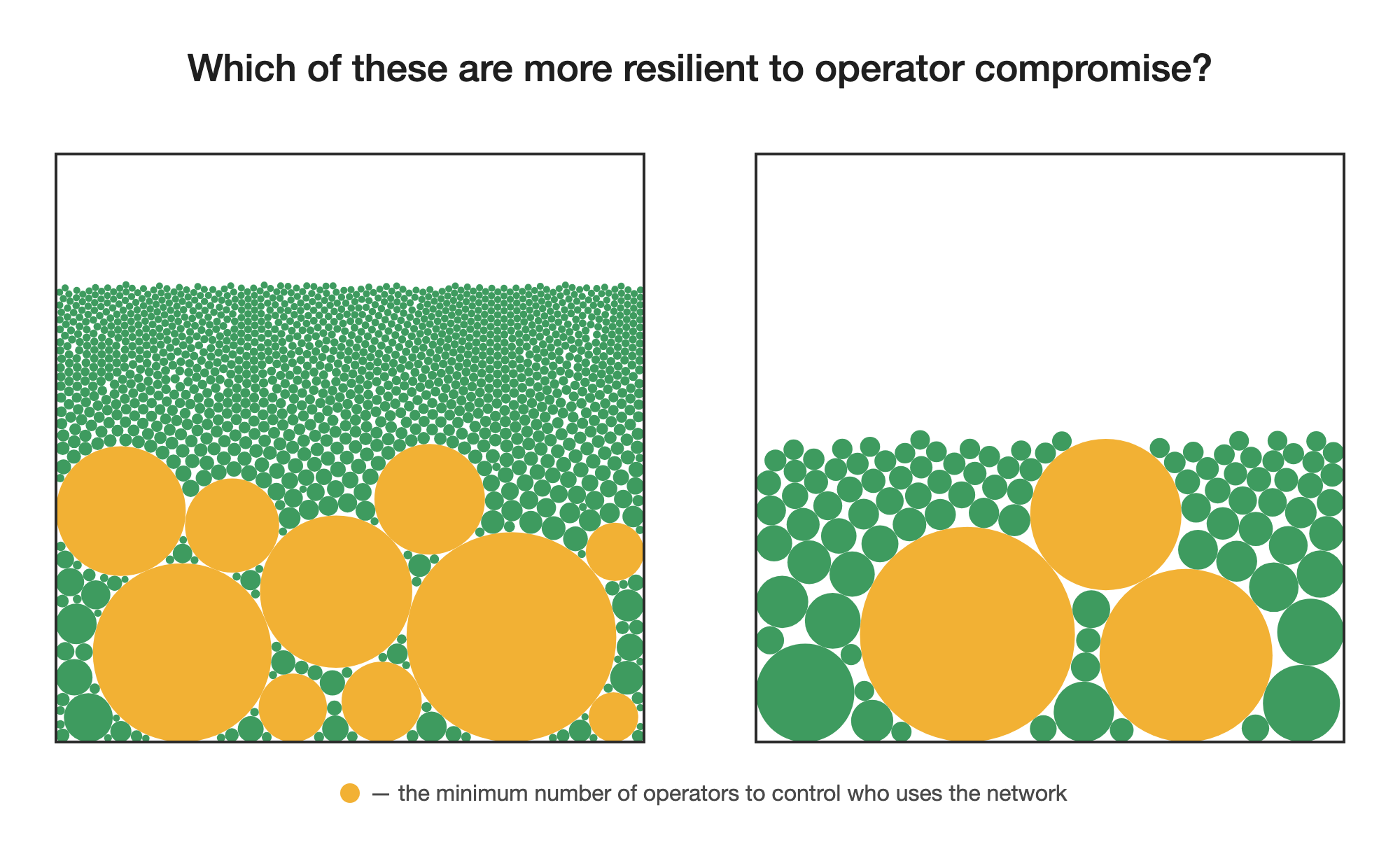
TL;DR: You’re correct that validity is not at stake, but this much eth is not the cost of a liveness, nor ordering failure, the $30b ‘economic security’ we have only covers finality failures. The security ‘budget’ of these other risks are far lower, and failure of these risks harming Etheruem’s CROPS mission, as well as ETH’s valuation far and above other chains considered to be more centralised than Ethereum. ($1m-$5m per day, maybe way less)
Liveness and ordering (whether everyone can use the chain and whether they are fairly ordered) are dictated by the chain’s Nakamoto co-efficient, not how much Ether that would be destroyed in a balancing attack.
Losing liveness (specifically Ethereum’s permissionlessness, where certain actors cannot use the chain because attesters will not attest to blocks with them in it) would be a failure of Ethereum’s CROPS objectives, and should be defended against vociferously.
To estimate the security budget of the CROPS of the chain. 2.6m slots per year currently gets ~960k eth per year, so ~0.365 ETH per slot right now. If equilibrium under this new proposal is at today’s stake rate, the security budget is 0.11 ETH, and in fact, that’s the total amount the delegators are being paid, the operators of the machines are two orders smaller, so bribing them to coordinate could cost a fraction of this amount, say 10% (in practice I would assume validators are co-erced into censoring not bribed into it, making Nakamoto even more vulnerable than the dollar figures to attack it imply, but to get a ballpark on the security anyways;).
At $2k eth, the chain’s security budget is likely less than $5m per day on the current setting, and less than $1.5m if equilibrium on the proposed curve is at >33%, which I believe it would be.
This is an order of 10,000x difference between the popularly termed ‘security budget’ of the chain, and I don’t believe this proposal recognises or models this alternative measure, nor does it research what this budget size might lead to in resulting nakamoto.
I acknowledge that the top-line issuance rate is not the only factor in how many operators there are, and how centralised the stake distribution is. Costs, delegation fees, liquidity profiles, and risks all come into play. All are un-modeled or presumed zero in this proposal. I believe they are extremely unfavourable, and I fear there aren’t good public resources for us to determine this from this proposal.
Lastly I will draw attention to @CelticWarrior 's conclusion, as I believe it to be true and extremely consequential.
what exactly are YOUR qualifications are for participating in this discussion?
absolutely toxic gate keeping
cheezus wtf am I reading here, has the Ethereum community already gone to complete shit then? this feels like /r/bitcoin all over banning discussion around block size upgrades
With <50% eth being staked you provably leave money you could earn on the table. You’re basically saying: “I don’t primarily care about money in the short term, I just want Ethereum to be as successfull as possible in the long run”.
So if you want to phrase it like that, yes.. with that I’m biased towards the success of the network.
Which bias should we trust more in this discussion? The short term “I want to milk ethereum for my financial gain” bias? Or the “I want ethereum to be long-term successful” bias?
The “milking” slander only make sense if you think that what issuance buys Ethereum is not value accretive. If taking Ethereum money and spending it on making it better secured, more decentralized, better and more used collateral in defi money legos etc makes it better choice for users to spend money on - then it’s perfectly fine to spend on and there’s no contradiction. This is source of much of resistance: a lot of folks (incl Lido, Rocketpool, Obol folks, many solo stakers) feel that what they do with issuance is value accretive and don’t feel it’s fair to be thrown under the bus.
So what does it mean if more ETH is staked than we actually want to be staked? We’re overpaying…!
“We” is doing a big lift in this statement. The whole point of this thread is there is no strong universal agreement that a cap on stake is desirable.
It’s really a contentious premise and you only make it more contentious by being dismissive of opponents which makes it less likely to be implemented.
When we say this proposal benefits ethereum who we define as ethereum?
DEFI (aave,lido) - Rejects it
Institutions (sharplink etc) - Reject it
Solo Stakers (multiple surveys) - Reject it
Validators (multiple surveys) - Reject it
Retail holders - cant measure
Reserchers (on this forum) - support it
One thing is I wouldn’t equate rejection of the proposal with dismissal of all the motivational points. The proposal is remarkably bad on multiple fronts IMO but the aims to resolve the conflict between smart and well-meaning groups of Ethereum enthusiasts so if it flops it will just keep the conflict unresolved.
With that type of incendiary rethoric, you should leave now. You are not providing anything constructive to this discussion and you are willingly taking this community down the drain. Shame on you.
Please refrain from cluttering this discussion with AI slop. Thx
Discourse provides native support for identifying sock puppet accounts - I have deleted many such accounts that were created in the past few days - they showed very high confidence correlation on multiple vectors. These accounts were (surprise) largely responsible for the degraded conversation quality and personal attacks. I’ll continue monitoring, please continue discussion.