Author: Henrique L. Alvim (@henriquelalvim)
Reference implementation: genealogicalRegistryBlockchain
Base Sepolia deployment: Base Sepolia Blockscout
TL;DR — I am proposing a standard for decentralized genealogical tree register, primarily used for genealogical tracking to verify pedigree. The proposed standard is this contract:
LineageRegistry.sol.ERC-721 tokens form a sexed DAG: each token carries a sex and a birth date, and is either a
founder or has exactly one sire and one dam. Six rules are mandatory, four extensions are opt-in behind ERC-165, and acyclicity needs no cycle check at all — it falls out of monotonic token IDs.The open questions at the end are what I actually want feedback on.
The problem I am actually trying to solve
For a pedigree animal, the pedigree is a large fraction of the value. The gap between a
documented and an undocumented animal of the same quality is not a rounding error — it is often most of the price.
That record lives in a studbook: a private database run by a breed association. If you are
buying, what you receive is a PDF. You cannot check it. You are trusting the association, and
transitively every clerk who ever typed into it.
This produces three failures that anyone in the industry will recognize:
- You cannot verify a claim, only receive it.
- Associations disagree about the same animal, and there is no mechanism to reconcile them —
the same horse exists twice, under two names, with two ancestries. - When an association fails, the ancestry dies with it. Registries have been lost to
bankruptcy, war, fire and simple neglect. The animals outlive the records.
Why ERC-721 alone does not solve it
Nothing stops you from putting "sire": 42 in your token metadata today. But metadata is a
claim, and nothing checks it. Specifically, nothing stops:
- a parent recorded as born after its own offspring;
- a cycle — an animal that is transitively its own ancestor;
- me naming your champion stallion as my foal’s sire, without ever asking you;
- one parent recorded and the other quietly missing, indistinguishable from an animal with no
known ancestry at all.
Each of these is a real thing that happens in real studbooks.
So the goal is not to put pedigrees on-chain — anyone can do that today. It is to replace the
private studbook with a decentralized one: a directed acyclic graph whose structural rules are
enforced at write time, by the contract, on every registration. No association owns it, no clerk
can rewrite it, and a reader does not have to trust that it is consistent — it cannot be anything
else.
What the tokens look like
ERC-721 tokens forming a sexed directed acyclic graph: every token carries its own sex and
birth date, and is either a founder or descends from exactly one sire (a male token) and one
dam (a female token).
struct Node {
    uint256 sireId;         // the father — a male token, or 0
    uint256 damId;          // the mother — a female token, or 0
    uint64  birthTimestamp; // ─┐ packed together into one storage slot
    bool    isMale;         // ─┘
}
Four facts, three storage slots, and token ID 0 is never minted so it doubles as the “no
recorded parent” sentinel.
Scope
The standard is ILineageRegistry and LineageRegistry.sol, the abstract contract that enforces
it: the node, the six rules below, and consent. It inherits ERC721 and nothing else — not even
AccessControl.
The repo also holds a concrete PedigreeRegistry, with breeds, animal names, studbook references
and death records. That one is not part of the proposal. It is a worked example of a domain
layer, there to prove the core is deployable and to give the gas numbers something real to measure.
About the vocabulary: sireId and damId are just parentMale and parentFemale, and I picked
the animal words deliberately. Pedigree animals are the use I actually understand, and the one I am
most confident this is correct for. I did not design it for plants — I do not know that field well
enough to claim it works there. I did not design it for people either: the data model would fit,
but tokenizing human descent raises ethical questions a token standard should not settle quietly.
Structurally the model is general — any genealogy of individuals with two parents of distinct sexes
fits it unchanged, and I would be glad to hear which of those it should officially claim. But the
scope I am proposing is animals.
Acyclicity is free
There is no cycle check anywhere in the contract, and the graph is still provably acyclic.
It falls out of two rules a registry wants for independent reasons:
- both parents must already exist when the offspring is minted, and
- token IDs increase monotonically.
Therefore a parent’s ID is always lower than its offspring’s. Following parent edges strictly
decreases the token ID, so a cycle cannot exist and an upward walk always terminates — without a
single comparison being written to enforce it.
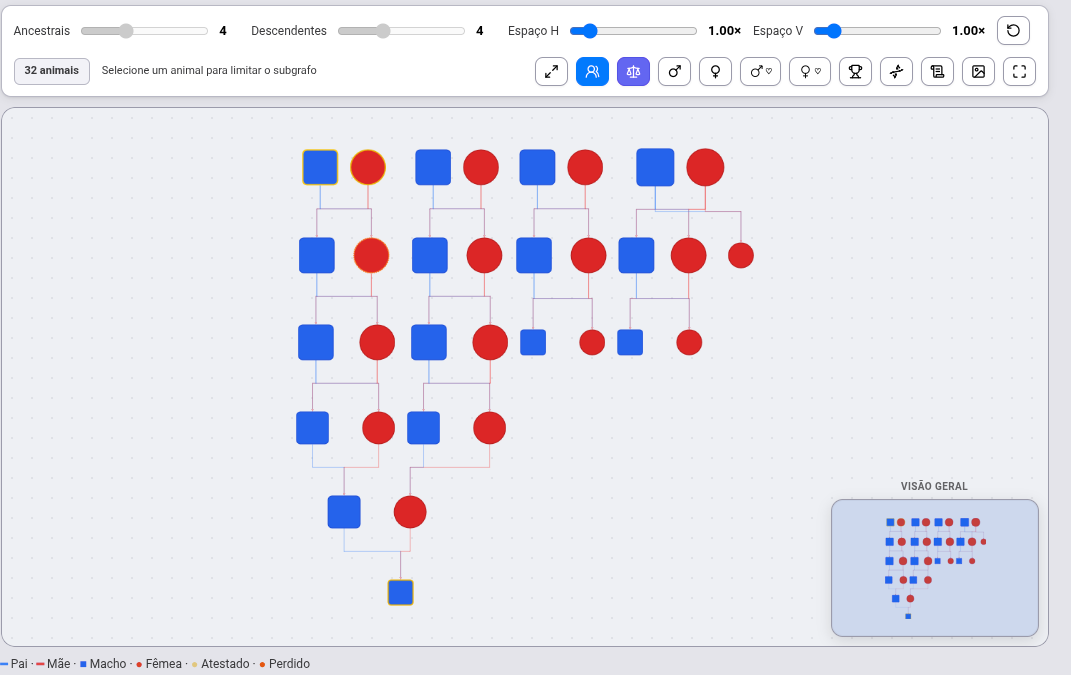
  #1 ♂   #2 ♀        #3 ♂   #4 ♀          founders — no recorded parents
    └──┬──┘            └──┬──┘
       │                  │
     #5 ♀              #6 ♂                sire #1, dam #2   /   sire #3, dam #4
       └────────┬─────────┘
                │
              #7 ♂                         sire #6, dam #5

  every edge points from a higher ID to a lower one — by construction, always
There’s also this demo I’m building, so you can visualize what is being tried to accomplish (sorry it’s in portuguese for now, but it’s intuitive):
This is not the chronology rule. Chronology is enforced separately and buys something else: the
promise that the pedigree describes something that could have happened in the physical world.
A foal born before its own sire is the most common form of bad studbook data, which is why that
rule is not optional either.
What is mandatory, and why exactly these
The test each rule had to pass: if this were optional, could you still trust the graph?
| Rule | Without it |
|---|---|
| Sexed parentage — a sire is male, a dam is female | the pedigree is not a pedigree |
| All-or-nothing parentage — both parents or neither | “no parents” and “one parent” become indistinguishable |
| Parents pre-exist and IDs are monotonic | acyclicity stops being free and needs an unbounded check |
| Write-once — recorded parentage is never overwritten | history is editable, and the record is worthless |
| Chronology — parents born strictly before the offspring | a foal can precede its own sire |
| Consent — naming a token as a parent needs its owner’s permission | anyone can hang their animal off your champion |
Consent is the one people do not expect, so: ancestry here is a mutually agreed record, not a
unilateral claim. Grants come per-token (“this stud may be named as a parent by that address”) or
blanket (“that address may name any token I own”). The blanket grant follows the owner, not the
token, so it covers animals bought later and lapses the moment one is sold.
The core interface (click to expand)
interface ILineageRegistry {
    struct Node {
        uint256 sireId;
        uint256 damId;
        uint64  birthTimestamp;
        bool    isMale;
    }

    event NodeRegistered(uint256 indexed tokenId, address indexed to, bool isMale, uint64 birthTimestamp);
    event ParentageLinked(uint256 indexed tokenId, uint256 indexed sireId, uint256 indexed damId);
    event ParentageLinkageApproved(uint256 indexed parentTokenId, address indexed linker, bool approved);
    event GeneralParentageLinkageApprovalSet(address indexed owner, address indexed linker, bool approved);

    // Consent
    function approveParentageLinkage(uint256 parentTokenId, address linker, bool approved) external;
    function approveParentageLinkageBatch(uint256[] calldata parentTokenIds, address linker, bool approved) external;
    function setGeneralParentageLinkageApproval(address linker, bool approved) external;
    function canUseAsParent(uint256 parentTokenId, address caller) external view returns (bool);
    function parentageLinkageApproval(uint256 parentTokenId, address linker) external view returns (bool);
    function generalParentageLinkageApproval(address ownerAddr, address linker) external view returns (bool);

    // Views
    function nextTokenId() external view returns (uint256);
    function isMale(uint256 tokenId) external view returns (bool);
    function birthTimestampOf(uint256 tokenId) external view returns (uint64);
    function getParents(uint256 tokenId) external view returns (uint256 sireId, uint256 damId);
    function getNode(uint256 tokenId) external view returns (Node memory);
    function getNodesBatch(uint256[] calldata tokenIds) external view returns (Node[] memory);
}
canUseAsParent deliberately takes the caller as an argument rather than reading
msg.sender, so one contract can ask the question on a third party’s behalf. That matters for
open question 7 below.
getNodesBatch is the intended traversal primitive: walk a pedigree breadth-first, one call per
generation. Generation n has at most 2ⁿ members, so this is the only shape of traversal that
stays affordable.
What is optional, and what that costs
Four extensions, each with its own ERC-165 ID, the way ERC721Metadata and ERC721Enumerable
relate to ERC-721. A deployment composes exactly the registry it needs, and consumers discover at
runtime what they got.
| Extension | Adds | Requires |
|---|---|---|
Offspring |
the reverse index: getOffspring, offspringCount |
— |
LateParentage |
attachParentage — promote a founder once, later |
— |
Mergeable |
fold a duplicate into a survivor, plus a forwarding tombstone | Offspring |
Burnable |
destroy a leaf node; anything with offspring is refused | Offspring |
One of those splits is worth a number, because it is why the standard is shaped this way at all.
| Stack | register with two parents |
|---|---|
| core only | 138,516 gas |
core + Offspring |
227,269 gas |
| full reference composition | 266,415 gas |
Offspring costs 88,753 gas — two cold SSTOREs per parented registration, comfortably more
than everything core does put together. And the same information is fully reconstructible
off-chain from ParentageLinked events.
So install it only if you have to answer “who are this stallion’s foals?” on-chain. A core-only
registry is 48% cheaper per registration and 59% smaller — which is what stopped me pushing more
into the mandatory core, including things I personally always want.
Objections I expect, answered in advance
Why exactly two parents? Why binary sex?
Because that constraint is the entire source of the guarantee. Sexed typing is what makes
“this pedigree is impossible” a computable statement rather than an opinion. Relax it to N
parents or unsexed edges and you are back to free-form metadata with extra steps — you keep the
gas cost and lose the reason to pay it.
The line is drawn at the reproduction model, not the species or the industry. What the
standard requires is that an individual has exactly two genetic parents of distinct sexes. What it
therefore cannot represent, and should not be stretched to:
- more than two genetic contributors — mitochondrial donation, some polyploid crosses;
- hermaphroditic or self-fertile species, where one individual can be both parents at once.
This is what rules out most crop plants, not “plants” as a category; - clonal or asexual propagation, where there is one parent or none in the relevant sense;
- social rather than genetic parentage — this records descent, not custody or family.
Those deserve their own standard rather than a weakened version of this one. Everything else that
reproduces sexually with two sexes is in scope, whether or not anyone calls it a pedigree.
Two cases that look like exclusions but are not:
- Embryo transfer / surrogacy — the dam is the genetic dam. The recipient female is domain
data, not a graph edge. Studbooks already draw this line exactly here. - Posthumous offspring — supported and deliberately so. Frozen semen and stored embryos are
routine; a deceased parent remains a valid parent, because the only temporal rule that matters
is that a parent was born first.
And one that is genuinely awkward rather than cleanly excluded: clones and parthenogenesis have
one genetic parent, which the all-or-nothing rule forces you to pair against a placeholder. See
open question 3.
Why is half a pedigree unrecordable?
(sireId == 0) == (damId == 0) always holds. A token is a founder or it has both parents.
Recording only the sire states half a fact while looking like a whole one, and it gives every
consumer three answers to “does this node have parents?” instead of two.
When only one parent is genuinely documented, the sanctioned pattern is a phantom placeholder:
register an unnamed founder of the missing sex and pair against it. The known parent is preserved,
the invariant holds, and the gap is visible as a nameless node instead of hiding inside a
half-filled record. Paper studbooks have always done this.
I am not fully comfortable with it — see open question 3.
Why is there no registrar role?
Registration is permissionless. There is no certification tier and no privileged registrar,
because a breed association that wants to attest to pedigrees should do so by participating,
not by gatekeeping — and because a standard with a built-in authority is a standard that
reproduces the exact failure mode described at the top of this post.
Core does not inherit AccessControl at all. Roles, where a deployment wants them, belong to the
domain layer above.
Known limitations
- Two unbounded ancestor walks, in
attachParentageand in the merge primitive. On a deep
pedigree either can exhaust gas — which would make those operations permanently impossible on
exactly the old, well-documented lines where they matter most. This is the weakest part of the
design. See open question 6. isMalereturnsfalsefor tokens that do not exist, so “female” and “absent” are
indistinguishable without a separate existence check. See open question 1.- Revert strings rather than custom errors, kept for legibility while the standard is being
drafted. - No frozen interface. Every ERC-165 ID moves if a signature changes.
- The test suite is a structured skeleton. Core, every extension and the reference composition
have been exercised end-to-end against a deployed instance, but the published suite is not yet
the proof it should be. I would not use this for real money today.
Open questions — these are the ones I actually want help with
1. bool isMale, or enum Sex { Unknown, Male, Female }? The enum fixes the “female vs.
absent” ambiguity above and leaves room for reproductive models this currently excludes. It is an
ABI change to the core, so it has to be settled before anything freezes.
2. Do monotonic token IDs cost something I have not noticed? They are what makes acyclicity
free, so I am attached to them. But they also mean the ID leaks registration order, that IDs cannot
be chosen — no deriving a token ID from an existing studbook number — and that importing a paper
studbook forces you to insert every ancestor before its descendants. Is there a worse consequence
I am not seeing?
3. Should the standard know about phantom placeholders? When only one parent is documented, the
all-or-nothing rule makes you invent the other: you register an empty, nameless founder of the
missing sex just to complete the pair. That node is a real token — transferable, usable as a parent
— standing for an animal that never existed. Nothing marks it as fictitious, so a consumer reading
the graph cannot tell a placeholder apart from a genuine undocumented founder. An isPlaceholder
flag would fix that and grow the core; leaving it out keeps the convention in the domain layer and
makes consumers guess. I do not know which is right.
4. Should attaching parents to an existing founder be part of the standard? It is optional
today, and it is the only operation that can break the ID-ordering argument — an attached parent
may hold a higher ID than its child, so it needs a real cycle check rather than a free one. The
need is real: you register an animal and its ancestry surfaces years later. Blessed by default,
kept optional, or left out?
5. Should merging duplicates be in the standard at all? The same animal registered twice is not
an edge case — it is exactly what happens when two breeders or two registries describe the same
animal, and it is one of the three problems I opened with. But folding one token into another means
reconciling parentage, walking ancestors to refuse a cycle, and leaving a forwarding tombstone so
old references still resolve. It is the most complex and most expensive thing in the repo, and it
is why I made it optional. Is that too much weight for a standard to carry — or is a genealogy
standard that cannot reconcile duplicates simply unfinished?
6. What do I do about the two unbounded ancestor walks? The obvious fix is a
MAX_ANCESTOR_DEPTH constant, and I am against it. A genealogical record is meant to keep
growing across generations — that is the entire reason to put it on a blockchain instead of in a
database — and a depth cap breaks the standard precisely on the old, deep, well-documented lines
that are worth the most. For the attach case there is a real fix: when the proposed parent’s ID is
already lower than the child’s, ID ordering alone proves safety and the walk can be skipped, which
covers the common path. For merging I have nothing good. Off-chain proof? A documented, accepted
limitation? Something I have not thought of?
7. Cross-registry linking — is on-chain even the right answer? A parent is a bare uint256
that must exist in this contract, so a token in someone else’s registry is not merely
unauthorized, it is unrepresentable. Three options: mirror nodes (import the foreign animal as
an ordinary local token with an origin pointer — no core change, local acyclicity intact, but a
fragmented getOffspring); widened references (chainId, registry, tokenId) (honest, and a
different ERC — the node triples, every read signature changes, and acyclicity degrades to a social
guarantee); or off-chain attestations consumed by an indexer (federation with no data-model
change, and it may well dominate the other two). I kept this out rather than guess. Should the core
reserve anything for it now?
8. One ERC with four optional extensions, or five ERCs? Written as one, following ERC-721’s
treatment of Metadata and Enumerable. The counter-argument is the ERC-1155 / ERC-1155 Supply split,
which keeps the core tiny at the cost of inter-ERC dependencies — Mergeable and Burnable both
require Offspring.
Happy to be told the framing is wrong. The thing I am least sure of is question 7, and the thing I
am most sure of is that the studbook problem is real and blockchain can solve it better, as the registers live onchain forever.