For the full ERC, see Add ERC: Scaled UI Amount Extension for ERC-20 Tokens by cridmann · Pull Request #1283 · ethereum/ERCs · GitHub
ABSTRACT
This EIP proposes a standard extension to ERC-20 tokens that enables issuers to apply an updatable multiplier to the UI (user interface) amount of tokens. This allows for efficient representation of stock splits, without requiring actual token minting or transfers. The extension provides a cosmetic layer that modifies how token balances are displayed to users while maintaining the underlying token economics.
MOTIVATION
Current ERC-20 implementations lack an efficient mechanism to handle real-world asset scenarios such as stock splits: When a company performs a 2-for-1 stock split, all shareholders should see their holdings double. Currently, this requires minting new tokens to all holders, which is gas-intensive and operationally complex. Moreover, the internal accounting in DeFi protocols would break from such a split.
The inability to efficiently handle this scenario limits the adoption of tokenized real-world assets (RWAs) on Ethereum. This EIP addresses these limitations by introducing a multiplier mechanism that adjusts the displayed balance without altering the actual token supply.
SPECIFICATION
The key words “MUST”, “MUST NOT”, “REQUIRED”, “SHALL”, “SHALL NOT”, “SHOULD”, “SHOULD NOT”, “RECOMMENDED”, “MAY”, and “OPTIONAL” in this document are to be interpreted as described in RFC 2119.
Interface:
interface IScaledUIAmount {
    // Emitted when the UI multiplier is updated
    event UIMultiplierUpdated(uint256 oldMultiplier, uint256 newMultiplier, uint256 setAtTimestamp, uint256 effectiveAtTimestamp);

    // Returns the current UI multiplier
    // Multiplier is represented with 18 decimals (1e18 = 1.0)
    function uiMultiplier() external view returns (uint256);

    // Converts a raw token amount to UI amount
    function toUIAmount(uint256 rawAmount) external view returns (uint256);

    // Converts a UI amount to raw token amount
    function fromUIAmount(uint256 uiAmount) external view returns (uint256);

    // Returns the UI-adjusted balance of an account
    function balanceOfUI(address account) external view returns (uint256);

    // Updates the UI multiplier (only callable by authorized role)
    function setUIMultiplier(uint256 newMultiplier, uint256 effectiveAtTimestamp) external;
}
Implementation Requirements:
-
Multiplier Precision: The UI multiplier MUST use 18 decimal places for precision (1e18 represents a multiplier of 1.0).
-
Backwards Compatibility: The standard ERC-20 functions (balanceOf, transfer, transferFrom, etc.) MUST continue to work with raw amounts.
-
Event Emission: The UIMultiplierUpdated event MUST be emitted whenever the multiplier is changed.
REFERENCE IMPLEMENTATION
contract ScaledUIToken is ERC20, IScaledUIAmount, Ownable {
    uint256 private constant MULTIPLIER_DECIMALS = 1e18;
    uint256 private _uiMultiplier = MULTIPLIER_DECIMALS; // Initially 1.0
    uint256 public _nextUiMultiplier = MULTIPLIER_DECIMALS;
    uint256 public _nextUiMultiplierEffectiveAt = 0;

    constructor(string memory name, string memory symbol) ERC20(name, symbol) {}

    function uiMultiplier() public view override returns (uint256) {
        uint256 currentTime = block.timestamp;
	   if (currentTime >= _nextUiMultiplierEffectiveAt) {
		return _nextUiMultiplier;
   } else {
      return _uiMultiplier;
   }
    }

    function toUIAmount(uint256 rawAmount) public view override returns (uint256) {
	   uint256 currentTime = block.timestamp;
        if (currentTime >= _nextUiMultiplierEffectiveAt) {
        	return (rawAmount * _nextUiMultiplier) / MULTIPLIER_DECIMALS;
        } else {
        	return (rawAmount * _uiMultiplier) / MULTIPLIER_DECIMALS;
   }
    }

    function fromUIAmount(uint256 uiAmount) public view override returns (uint256) {
	   if (currentTime >= _nextUiMultiplierEffectiveAt) {
return (uiAmount * MULTIPLIER_DECIMALS) / _nextUiMultiplier;
   } else {
	return (uiAmount * MULTIPLIER_DECIMALS) / _uiMultiplier;
    }

    }

    function balanceOfUI(address account) public view override returns (uint256) {
        return toUIAmount(balanceOf(account));
    }

    function setUIMultiplier(uint256 newMultiplier, uint256 effectiveAtTimestamp) external override onlyOwner {
        require(newMultiplier > 0, "Multiplier must be positive");

	   uint256 currentTime = block.timestamp;
        require(effectiveAtTimestamp > currentTime, "Effective At must be in the future");

	   if (currentTime > _nextUiMultiplierEffectiveAt) {
	uint256 oldMultiplier = _nextUiMultiplier;
	_uiMultiplier = oldMultiplier;
	_nextUiMultiplier = newMultiplier;
     _nextUiMultiplierEffectiveAt = effectiveAtTimestamp;
     emit UIMultiplierUpdated(oldMultiplier, newMultiplier,    block.timestamp, effectiveAtTimestamp);
   } else {
	uint256 oldMultiplier = _uiMultiplier;
     _nextUiMultiplier = newMultiplier;
     _nextUiMultiplierEffectiveAt = effectiveAtTimestamp;
     emit UIMultiplierUpdated(oldMultiplier, newMultiplier,    block.timestamp, effectiveAtTimestamp);
   }
    }
}
RATIONALE
Design Decisions:
-
Separate UI Functions: Rather than modifying the core ERC-20 functions, we provide separate UI-specific functions. This ensures backward compatibility and allows integrators to opt-in to the UI scaling feature.
-
18 Decimal Precision: Using 18 decimals for the multiplier provides sufficient precision for most use cases while aligning with Ethereum’s standard decimal representation.
-
No Automatic Updates: The multiplier must be explicitly set by authorized parties, giving issuers full control over when and how adjustments are made.
-
Raw Amount Preservation: All actual token operations continue to use raw amounts, ensuring that the multiplier is purely a display feature and doesn’t affect the underlying token economics.
Alternative Approaches Considered:
-
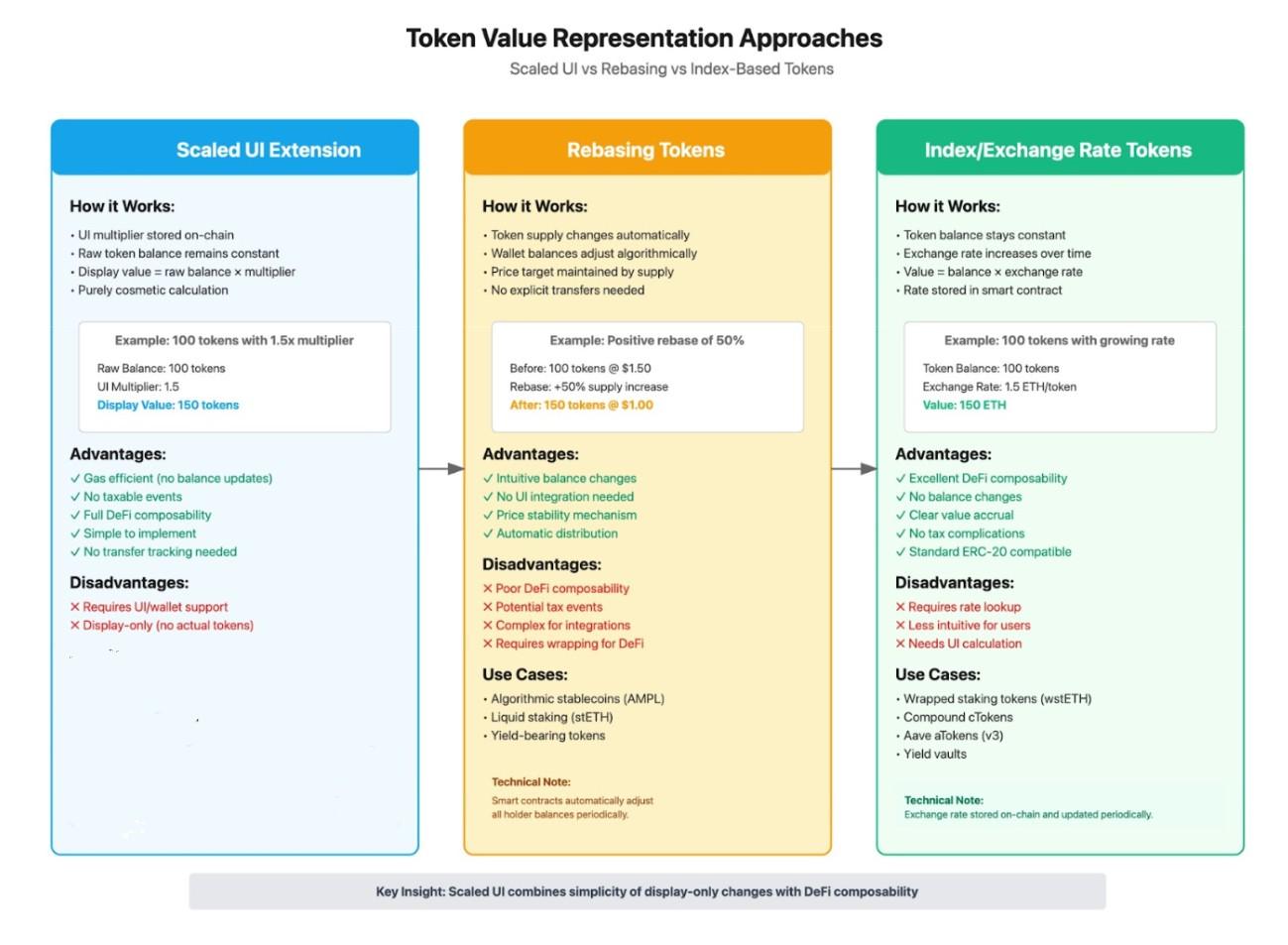
Rebasing Tokens: While rebasing tokens adjust supply automatically, they create complexity for integrators and can break composability with DeFi protocols.
-
Wrapper Tokens: Creating wrapper tokens for each adjustment event adds unnecessary complexity and gas costs.
-
Index/Exchange Rate Tokens confer similar advantages to the proposed Scaled UI approach, but is ultimately less intuitive and requires more calculations on the UI layers.
-
Off-chain Solutions: Purely off-chain solutions lack standardization and require trust in centralized providers.

BACKWARDS COMPATIBILITY
This EIP is fully backwards compatible with ERC-20. Existing ERC-20 functions continue to work as expected, and the UI scaling features are opt-in through additional functions.
TEST CASES
Example test scenarios:
- Initial Multiplier Test:
-
Verify that initial multiplier is 1.0 (1e18)
-
Confirm balanceOf equals balanceOfUI initially
- Stock Split Test:
-
Set multiplier to 2.0 (2e18) for 2-for-1 split
-
Verify UI balance is double the raw balance
-
Confirm conversion functions work correctly
SECURITY CONSIDERATIONS
- Multiplier Manipulation
-
Unauthorized changes to the UI multiplier could mislead users about their holdings
-
Implementations MUST use robust access control mechanisms
-
The setUIMultiplier function MUST be restricted to authorized addresses (e.g., contract owner or a designated role).
- Integer Overflow
-
Risk of overflow when applying the multiplier
-
Use SafeMath or Solidity 0.8.0+ automatic overflow protection
- User Confusion
-
Clear communication is essential when UI amounts differ from raw amounts
-
Integrators MUST clearly indicate when displaying UI-adjusted balances
- Oracle Dependency
-
For automated multiplier updates, the system may depend on oracles
-
Oracle failures or manipulations could affect displayed balances
- Overflow Protection: Implementations MUST handle potential overflow when applying the multiplier.
IMPLEMENTATION GUIDE FOR INTEGRATORS
WALLET INTEGRATION
Wallets supporting this standard should:
-
Check if a token implements IScaledUIAmount interface
-
Display both raw and UI amounts, clearly labeled
-
Use balanceOfUI() for primary balance display
-
Handle transfers using raw amounts (standard ERC-20 functions)
Example JavaScript integration:
async function displayBalance(tokenAddress, userAddress) {
    const token = new ethers.Contract(tokenAddress, ScaledUIAmountABI, provider);

    // Check if scaled UI is supported
    const supportsScaledUI = await supportsInterface(tokenAddress, SCALED_UI_INTERFACE_ID);

    if (supportsScaledUI) {
        const uiBalance = await token.balanceOfUI(userAddress);
        const rawBalance = await token.balanceOf(userAddress);
        const multiplier = await token.uiMultiplier();

        return {
            display: formatUnits(uiBalance, decimals),
            raw: formatUnits(rawBalance, decimals),
            multiplier: formatUnits(multiplier, 18)
        };
    } else {
        // Fall back to standard ERC-20
        const balance = await token.balanceOf(userAddress);
        return {
            display: formatUnits(balance, decimals),
            raw: formatUnits(balance, decimals),
            multiplier: "1.0"
        };
    }
}
EXCHANGE INTEGRATION
Exchanges should:
-
Store and track the multiplier for each supported token
-
Display UI amounts in user interfaces
-
Use raw amounts for all internal accounting
-
Provide clear documentation about the scaling mechanism
Example implementation:
class ScaledTokenHandler {
    async processDeposit(tokenAddress, amount, isUIAmount) {
        const token = new ethers.Contract(tokenAddress, ScaledUIAmountABI, provider);

        let rawAmount;
        if (isUIAmount && await this.supportsScaledUI(tokenAddress)) {
            rawAmount = await token.fromUIAmount(amount);
        } else {
            rawAmount = amount;
        }

        // Process deposit with raw amount
        return this.recordDeposit(tokenAddress, rawAmount);
    }

    async getDisplayBalance(tokenAddress, userAddress) {
        const token = new ethers.Contract(tokenAddress, ScaledUIAmountABI, provider);
        const rawBalance = await this.getInternalBalance(userAddress, tokenAddress);

        if (await this.supportsScaledUI(tokenAddress)) {
            return await token.toUIAmount(rawBalance);
        }
        return rawBalance;
    }
}
DEFI PROTOCOL INTEGRATION
DeFi protocols should:
-
Continue using raw amounts for all protocol operations
-
Provide UI helpers for displaying adjusted amounts
-
Emit events with both raw and UI amounts where relevant
-
Document clearly which amounts are used in calculations
Copyright
Copyright and related rights waived via CC0.
