Discussion topic for ERC-7972, RWA’s: RWA compliance router for RWA’s(security tokens) · Add ERC: Universal Compliance Router for RWA's by deepanshu179 · Pull Request #1087 · ethereum/ERCs · GitHub
Summary:
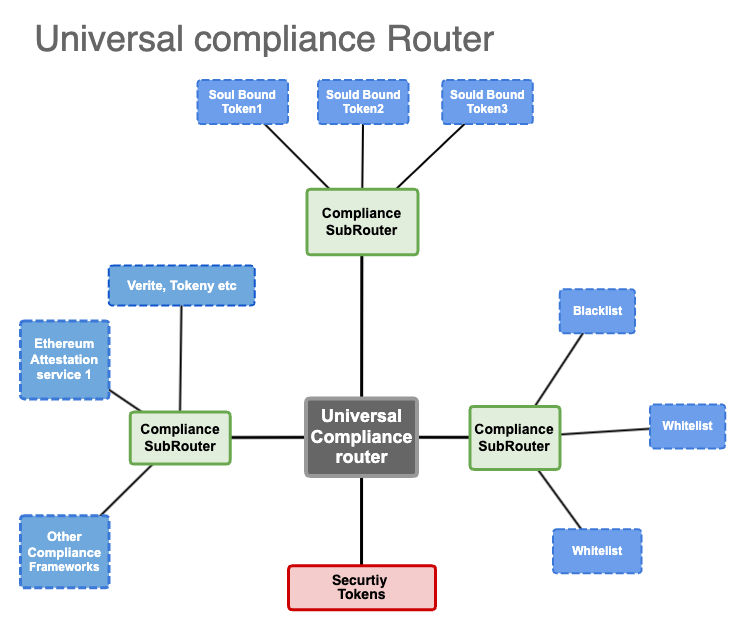
The RWA Compliance Router (ERC-7972) is a smart contract middleware that enables modular compliance for tokenized Real-World Assets (RWAs). It integrates seamlessly with:
- DIDs (Decentralized Identifiers) for universal identity resolution
- OnchainID for verified, on-chain identity and compliance metadata
- Soulbound Tokens (SBTs) to represent non-transferable credentials like KYC, accreditation, or residency
- On-chain compliance modules (e.g., KYC/AML, investor limits, blacklists)
Motivation:
On-chain compliance for tokenized real-world assets (RWAs) such as money market funds, real estate, private equity, and fixed-income securities etc. is becoming essential as adoption increases. Regulatory frameworks (KYC, AML, accredited investor rules, jurisdiction-specific rules) are often complex, evolving, and differ across asset classes and countries.
Currently, developers hardcode compliance logic into token contracts or wrap tokens with enforcement proxies. These approaches are:
- Inflexible: They require contract redeployments to update rules.
- Siloed: Each protocol creates and audits its own compliance logic.
- Non-composable: Tokens, marketplaces, and identity services cannot easily interoperate.
This results in duplicated effort, increased audit surface, and fragmentation across ecosystems.
We need a shared, modular, and extensible compliance layer that:
- Allows for dynamic updates to compliance rules
- Enables jurisdiction-specific enforcement logic
- Promotes reuse and composability across protocols
- Encourages collaboration between identity providers, compliance services, and token issuers
The RWAComplianceRouter addresses these needs by serving as a pluggable registry and execution layer for compliance modules that can be applied across different asset types, jurisdictions, and lifecycle events.
Rationale:
The RWAComplianceRouter is designed with the following decisions:
-
Modular Contract Registration: Compliance contracts are registered with their corresponding function selectors (
bytes4) to allow for diverse validation logic without assuming fixed interfaces. This allows backwards-compatible upgrades and supports heterogeneous compliance frameworks. -
Staticcall: Compliance checks are invoked via
staticcall, ensuring they are read-only and cannot modify state. This makes the router safe to integrate with other on-chain systems and supports off-chain simulation for auditability. -
Dual Registry Design: The router maintains separate lists for:
- General compliance contracts: which apply globally,
- Jurisdiction-aware contracts: which are checked conditionally based on the user’s jurisdiction (passed as a
bytes32identifier).
Note: The router interface can extended to perform additional checks not limited to just above checks.
This split improves clarity and allows different enforcement strategies to coexist.
-
Iterative Check Model: The router returns
trueon the first passing check. This conservative model optimizes for gas efficiency while enabling compliance layering. -
Owner-controlled Registration: To avoid misuse, only the deployer (or designated admin) can register or remove compliance modules. This can later be extended to role-based or DAO-based control models.
This architecture provides a low-coupling, high-composability mechanism for evolving compliance logic that can serve as shared infrastructure for the RWA ecosystem.
Update Log
- 2025-06-16: review
- 2025-06-16: ERC-7972 under review
External Reviews
2 as of 2025-07-21
Outstanding Issues
None as of 2025-06-16.