Can’t get to all this thread so I’ll pick just one important point from @jdetychey 's first posts to add to the record for now.
TL;DR: You’re correct that validity is not at stake, but this much eth is not the cost of a liveness, nor ordering failure, the $30b ‘economic security’ we have only covers finality failures. The security ‘budget’ of these other risks are far lower, and failure of these risks harming Etheruem’s CROPS mission, as well as ETH’s valuation far and above other chains considered to be more centralised than Ethereum. ($1m-$5m per day, maybe way less)
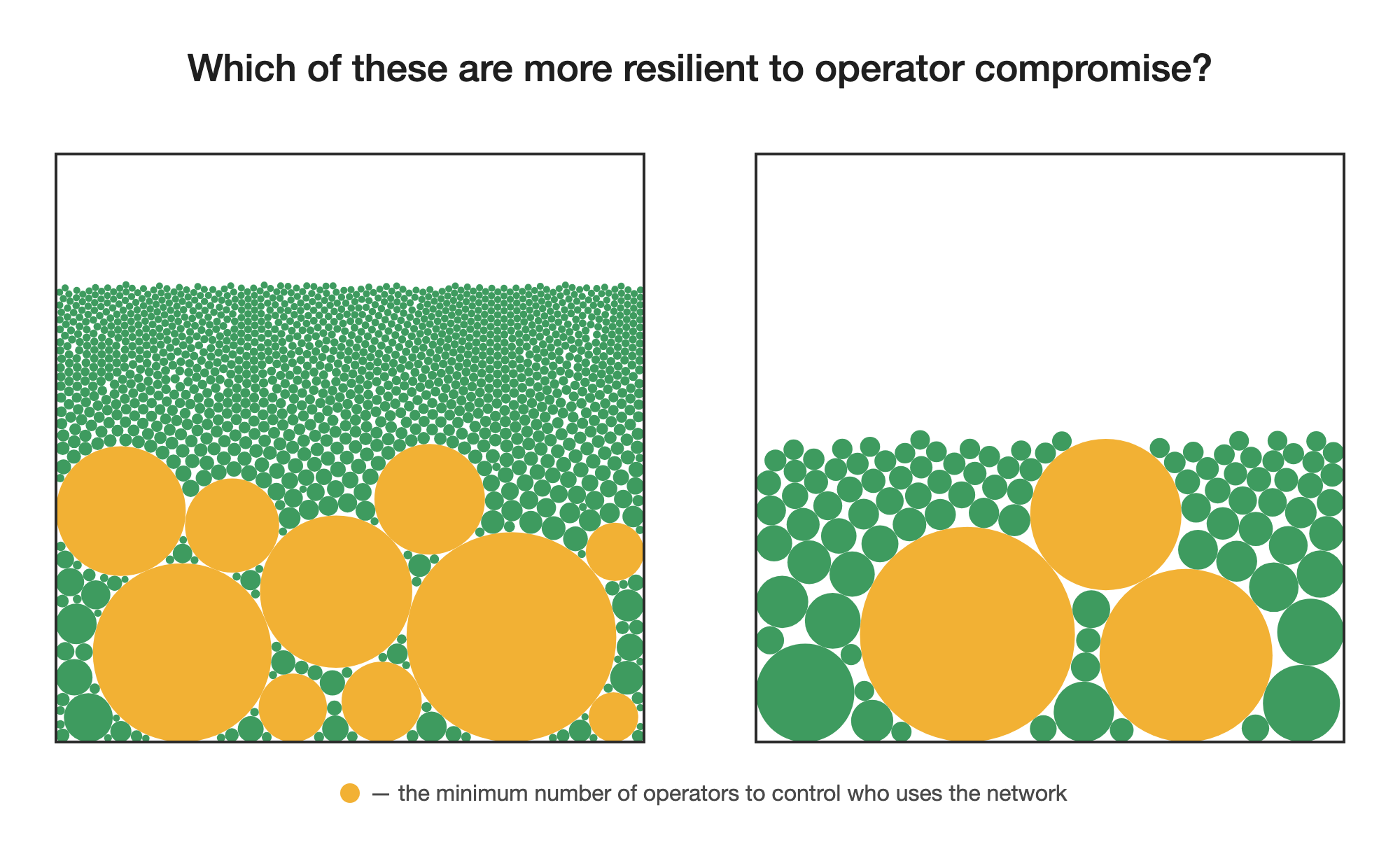
Liveness and ordering (whether everyone can use the chain and whether they are fairly ordered) are dictated by the chain’s Nakamoto co-efficient, not how much Ether that would be destroyed in a balancing attack.
Losing liveness (specifically Ethereum’s permissionlessness, where certain actors cannot use the chain because attesters will not attest to blocks with them in it) would be a failure of Ethereum’s CROPS objectives, and should be defended against vociferously.
To estimate the security budget of the CROPS of the chain. 2.6m slots per year currently gets ~960k eth per year, so ~0.365 ETH per slot right now. If equilibrium under this new proposal is at today’s stake rate, the security budget is 0.11 ETH, and in fact, that’s the total amount the delegators are being paid, the operators of the machines are two orders smaller, so bribing them to coordinate could cost a fraction of this amount, say 10% (in practice I would assume validators are co-erced into censoring not bribed into it, making Nakamoto even more vulnerable than the dollar figures to attack it imply, but to get a ballpark on the security anyways;).
At $2k eth, the chain’s security budget is likely less than $5m per day on the current setting, and less than $1.5m if equilibrium on the proposed curve is at >33%, which I believe it would be.
This is an order of 10,000x difference between the popularly termed ‘security budget’ of the chain, and I don’t believe this proposal recognises or models this alternative measure, nor does it research what this budget size might lead to in resulting nakamoto.
I acknowledge that the top-line issuance rate is not the only factor in how many operators there are, and how centralised the stake distribution is. Costs, delegation fees, liquidity profiles, and risks all come into play. All are un-modeled or presumed zero in this proposal. I believe they are extremely unfavourable, and I fear there aren’t good public resources for us to determine this from this proposal.
Lastly I will draw attention to @CelticWarrior 's conclusion, as I believe it to be true and extremely consequential.