Ethereum is accelerating the post-quantum transition. To that end, we’re rescoping Hegotá. I think we should decide what to ship by looking at where each feature sits in the research, development and testing pipeline and how much work can move forward in parallel.
PQ Decoupled Consensus is seen as an ideal design for PQ-resistant Ethereum. Decoupled Consensus is the culmination of more than four years of research and would significantly improve the consensus layer. It would also make the PQ transition easier by moving signature aggregation off the critical path. However, it’s still in active research. Its design space is still being explored, and the initial spec is still in progress.
As an alternative, PQ Gasper was proposed as an emergency PQ transition fork. The PQ Gasper devnet is already up and running. We should use this opportunity to run benchmarks, such as measuring broadcast times and bandwidth consumption for M attestations and N aggregates respectively. It also gives us a place to prototype future p2p changes such as Waggle, SEACAST and fast proof broadcast. Unfortunately, it’s moving away from that original vision. PQ Gasper poses difficult questions about raising hardware and bandwidth requirements, whether to introduce an aggregator role, what p2p changes to adopt, whether to remove sync committee and so on. All of these make it unclear whether we should ship PQ Gasper unless there’s clear evidence of an imminent security threat.
Whichever we choose, PQ consensus is still far from graduating from the research phase. Furthermore, both designs rely on leanVM for signature aggregation, which is still unsettled. More people need to review leanVM, and the protocol design and leanVM affect each other in decisions such as which signature scheme to use and whether or not to aggregate signatures. PQ DC is in a better position because aggregation is out of the critical path, but it’s a big architectural change and research is still ongoing.
In the research, development and testing pipeline, this puts PQ consensus in the research phase.
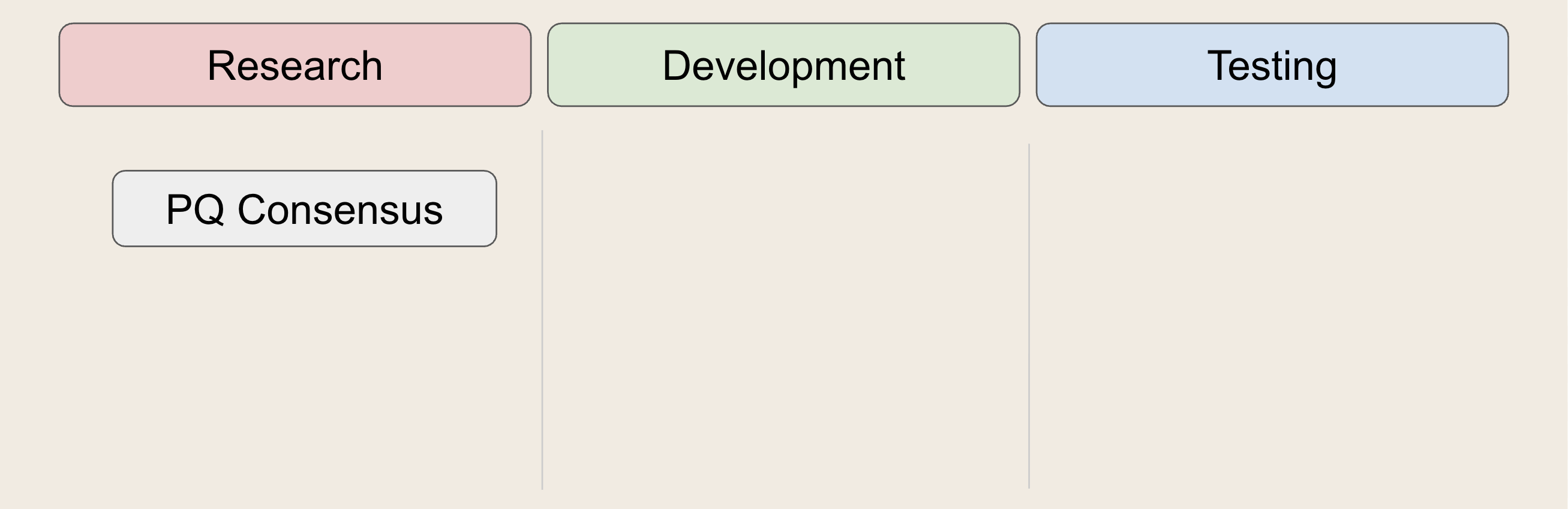
Assuming no spec change will be made on the EL, January is a plausible target for Glamsterdam. If we chose a feature that’s still in research, we would have developer capacity sitting idle for months.
On the other hand, there is still some work that can proceed. PQ preregistration can be the first step in the PQ CL pipeline. This can ship shortly after Glamsterdam as a CL-only fork, say in April. If the CL goes with RLP to avoid delaying Glamsterdam, that fork could also include #5820 (committing to the payload root in a bid). Still, I expect a few more months before client teams can start implementing PQ consensus for mainnet.
One option is to use that time for client hardening. It’s worthwhile work, but given that we’ve already been doing this work and would focus on frozen features, I’m not sure whether putting all our idle developer capacity into hardening for several months would be the best use of that time.
Another route is to use the available engineering capacity to ship a feature. A CFI’d feature such as EIP-8148 or some network optimization could fill that slot, but coincidentally the SFI’d headliner shows the most mature readiness. The diagram below illustrates where the work is concentrated.
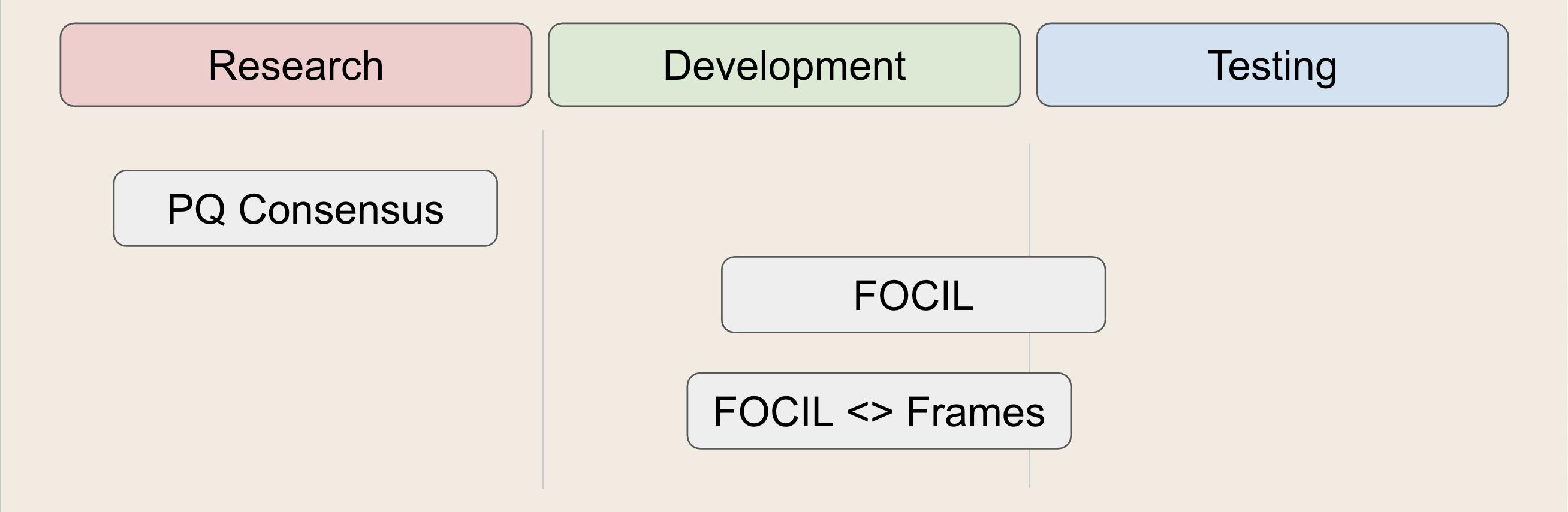
Needless to say, FOCIL already has devnets and is well understood among researchers and client devs. It could enter the hardening phase soon. FOCIL <> Frames is waiting for its development and testing cycle to begin. Hegotá as-is can move through development and testing while PQ consensus is still in research. I expect most of the FOCIL work to be done by the time PQ consensus moves into client development, so shipping FOCIL in Hegotá should have a limited impact on the PQ timeline.
FOCIL will eventually need to work with PQ consensus whichever ships first. Running with no idle resources is the faster way to get to the same destination. Dropping all features and going all in on PQ consensus might therefore be suboptimal.
Putting more people with deep protocol knowledge on PQ consensus will accelerate the PQ roadmap. It’s tempting to assume that putting more people on the job will make it go faster. However, it’s always been the handful of experts who know the feature inside out who actually move it forward. We should avoid the mythical man-month trap. Additionally, people have different skill sets and appetites for different kinds of work. While some protocol experts work on PQ consensus research, those who specialize in development and testing can move other features forward.
I propose we keep FOCIL in Hegotá and develop PQ DC in parallel, with PQ preregistration as the natural first step in the PQ CL pipeline.