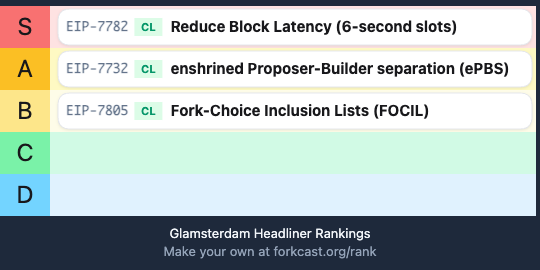
What stakeholder category do you represent?
Bridges – specifically Snowbridge, a trustless, light-client-based bridge between Ethereum and Polkadot.
What do you view as the top priority theme in this fork & why?
Faster finality: Trustless bridging is only viable if the user experience is competitive with centralized multisig bridges. When finality delays are excessive, users opt for less secure but faster alternatives. If we want to preserve decentralization in the bridging space, we must reduce Ethereum’s time to finality.
Which EIP(s) do you favor as a headliner for Glamsterdam?
EIP-7782: Time to finality is the primary UX bottleneck for Snowbridge. Halving block times would halve the time it takes for a transaction to finalize on Ethereum, offering a major improvement to the bridging experience.
If known, what specific impacts would this have on your community?
It would dramatically improve the speed and usability of trustless Ethereum → Polkadot transfers. Polkadot users are accustomed to ~1–2 minute delays. The current ~13–15 minute finality wait from Ethereum is a major friction point that deters usage and limits adoption.
Does anything make this an urgent feature for you or your community?
Absolutely. We are losing users and integrations due to Ethereum’s slow finality. It also restricts the types of bridge applications that can be built, such as arbitrage, payments, or real-time interactions, where latency is a critical constraint.
The leading headliners among client teams are described in a series of blog posts listed here. Do you have any concerns about any particular proposal?
No concerns at this time.
Any additional comments?
We’re excited to see Ethereum continue evolving in ways that preserve decentralization without compromising usability. Reduced block latency would be a milestone for bridges and cross-chain apps. We’re eager to support and build on a faster, more responsive Ethereum.