EIP-8363: Tapered Issuance Burn

As a solo staker, here are my thoughts:

The worst-case scenario we should avoid is excessive dilution that creates unnecessary costs for ETH holders and the broader ecosystem. This is an issue that should be addressed proactively.

Many people argue that reducing issuance will hurt solo stakers, but the relationship between solo staking participation and yield is not straightforward. Even with the current curve, if the overall staking ratio continues to increase, dilution-adjusted returns will continue to decline.

The biggest barriers for solo stakers are the 32 ETH minimum, significant hardware and network requirements, and the complexity of setup and maintenance. These are challenges that should be addressed through technical improvements that reduce the cost and complexity of participation.

Realistically, the more fundamental goal is to prevent any single entity among the largest existing staking participants from gaining disproportionate control over the validator set. This is a problem that requires targeted solutions beyond issuance policy alone.

Finally, on a personal note, I find a downward-sloping straight line simpler and more mathematically elegant. I understand that the proposed issuance curve needs additional complexity because it is designed to provide a smoother transition from the existing model.

3 Likes

I am a solo validator since January 2021. A lot has been said on the technical side, I will just share my 2 cents briefly: the share of solo stakers over time has trended in precisely one direction: down. The reason is obvious, and it is that 1) the disincentive of not staking ETH only goes up as the total stake increases, since that also means that issuance increases and there is more dilution of non-staked holdings. 2) institutional parties reap greater and greater economies of scale the higher the stake. Individual yields go down as the stake grows higher, but institutions can at least offset this against rising income (as they will attract part of the new stake). Solo stakers cannot.

I understand the opprobrium from solo stakers, because they are already feeling squeezed. Unfortunately, the current curve will only squeeze us more. Under the current issuance curve, solo stakers will, inevitably, be pushed out.

We need to reduce the total stake, before the big interests against it become entrenched. It is urgent and necessary. Vitalik Buterin called for targeting 25% stake in the Ethereum foundation’s 11th Reddit AMA of January 2024 (I can’t include links). In the 14th Reddit AMA of August last year Justin Drake wrote the following:

Issuance is Ethereum’s equivalent of global warming. It slowly creeps over, year after year. I remain optimistic that as the negative externalities become increasingly acute, and as the community increasingly appreciates the difference between nominal and real staking yields, urgency will increase.

There is arguably a limited window of opportunity to take action because core features of Ethereum like issuance naturally tend towards ossification. I would hope that issuance is addressed within the next 5 years, ideally sooner.

IMO we need an issuance champion.

Thanks for stepping up!

3 Likes

I’ve been informed that comments outside the “safe space” of this antiquated message forum will not/should not be considered as part of the ACD process debating this EIP for inclusion, as people outside this forum are low-IQ or don’t really hold ETH or whatever, so here are my objections to this proposal distilled from stuff I’ve already said in more relevant/broader and accurately sentiment-measuring public town squares:

Do not rewrite Ethereum’s monetary policy today to pre-empt an unobserved future staking problem, especially when the intervention is likely to require redesign soon and will preferentially damage solo/decentralized stakers while strengthening centralized exchanges.

1. No urgent problem exists today.

Ethereum’s current issuance and staking ratio (~33%) do not create measurable harm. Net dilution is already low (and frequently near-neutral after burns). There is no evidence that current issuance is driving away investors, holders, or builders. More staking can be net-positive: it locks ETH, increases long-term commitment, and strengthens economic security. Advocates must first show why more stake is intrinsically bad and, if bad, at what % it becomes bad (every incremental % above 30?) and, assuming all that, why intervention is required now.

2. The feared end-states are speculative and overstated.

Claims that staking will inevitably hit 50%+ (or approach 100%) rest on weak analogies. Even high-reward, low-friction environments (Terra at peak with 15%+ APR + airdrops + liquidity mining + in-protocol LST + QE macro) did not produce universal staking. Staking still carries real costs and risks (slashing, smart-contract, custody, liquidity fragmentation). Other PoS networks with generous rewards also stop well short of 100%. Act on observed problems, not projected ones that may never materialize.

3. The proposal does not (and cannot) net-reduce intermediation.

Ethereum does not control the full supply of validator rewards. Large centralized players (Coinbase, Kraken, etc.) can and do offer extra incentives outside the protocol—leverage on staked ETH, bundled services, superior MEV capture, TVL competition, etc. Pure protocol-based solutions (Lido) and solo stakers cannot match this. Cutting protocol issuance therefore hits decentralized and solo options harder while leaving CEX-controlled stake relatively resilient. Result: capital migrates from Lido-style trust-minimized staking toward centralized custodians—the opposite of the stated decentralization goal. You cannot reduce both Lido and Coinbase; the proposal selectively weakens the better form of intermediation, while also likely reducing non-intermediated (solo) stakers as well thus possibly net increasing intermediation in general.

4. Timing and process are wrong.

This is a major monetary-policy change. Lean Ethereum and related roadmap items will redefine validator roles, duties, and the full set of parties that need to be compensated. Changing the issuance curve now almost guarantees reopening the entire question shortly afterward. Better to wait until the reward landscape is clearer rather than lock in a curve that may soon be obsolete. Persons with related similar proposals differing in details have been soft-coerced into standing down so that the community can unite behind this one kingmade by justin drake. The proposal is undermotivated relative to its scale and has been advanced in a highly politicized way

5. Public justifications vs. private motivations.

It’s well known in certain circles that at least part of the real motivation behind this post is to reduce the # of validators to make L1 scaling easier. Thus the public framing (dilution, “capture resistance,” soft cap at 50%) does not fully match the real motivations and we are being partially deceived/gaslit through a deliberate psyops process. This also explains why the proponents of the proposal are oddly resistant to clearly articulating any real problem solution statement that does not simply restate the premise that more staking is bad–they can’t do it, as if the proposal were explicitly aimed at reducing # of validators and thus decentralization it would have even less of a chance of passing.

-Gabriel Shapiro, @lex_node, Esq., raw unstaked ETH holder for nearly 100% of net worth, MetaLeX founder/builder

15 Likes
  1. Trying to tweak issuance/inflation at this moment, ~10 years into Ethereum existence, is wrong headspace. Even if we assume that the model is not perfect, this is dwarfed by the main Ethereum need at this stage: ADOPTION
  2. Blockchain trilemma: decentralisation, security, and scalability. Ethereum arguably solved that. While most of the discussion focuses on economic impacts of one issuance scheme over other, I have noticed there are no talks about its impact on decentralisation and security, which risk collapse that could leave Ethereum with perfect issuance policy on dead blockchain. Let’s not risk that
  3. Real-world modern optimal: 2% is almost universally desired inflation target for all global economies, with monetary policies matching that rate. Gold growth rate YoY is averaging 1.67%. Proven by centuries of economic activity, there is no need for Etehreum to reinvent the wheel

Conclusion: this proposal is garbage, especially taking into consideration HOW it’s been put forth

9 Likes

Gm, Anthony CEO of Aragon here:

I don’t believe EIP-8363 is net beneficial for Ethereum nor ETH. I think the timing of this EIP regardless of ones beliefs is poor. My reasoning below:

1. Punishes solo stakers: pushes staking to custodians, ETFs, and exchanges.

2. Reliance on MEV: As issuance drops, MEV increases from 7% to 30% of validator revenue. MEV favors massive pools and non-neutral, censoring relays over fair block production.

3. Negative impact on DeFi (major use-case): Killing it negatively impacts DeFi lending curves and forces capital into stablecoins or BTC, turning ETH into a low-yield funding asset.

4. Predictability: Building onchain is similar to building in a jurisdiction without clear regulations. You don’t have clarity or confidence to make long-term decisions that won’t be impacted by external factors outside of your control. It’s like building on quicksand (and Ethereum exists exactly not to be like this).

Building a product is tough enough but when the foundation of what you are building on shifts your ability to adjust is critical, and if you can’t you die. It’s why regulations shouldn’t change often or quickly.

Switzerland has built a MOAT on this (clear, never changing), the USA historically has as well (pro-builder).

Ethereum should not make decisions lightly that could have a catastrophic impact on its #1 user base (DeFi), it erodes confidence at best and implodes users at worst.

Decisions like this should (if at all) be rolled out over much longer time horizons and with users as the first stakeholders to engage.

Right now besides stablecoins and prediction markets the industry is reeling. We need stability and support not foundational shifts that change the rules of the game.

EIP-8361 changes the rules of the game and needs more thought and care over a longer duration to manage. I’m confident there is a better, longer-term proposal that could be worked on that hedges the risks indicated in the proposal while not damaging Ethereum’s existing userbase.

Thank you,
Anthony

8 Likes

The Tapered Issuance Burn proposal is a technically sophisticated version of an argument that has been circulating in Ethereum research circles for two years. It deserves credit for its elegance. But it also deserves scrutiny for what it conceals.

The headline claim is modest: a tapered burn that removes the yield incentive to stake beyond 50% of ETH supply, phased in gently over 18 months. The reality is considerably more aggressive. At today’s 33% staking ratio, the permanent post-transition yield collapses to approximately 1.2% — not the 1.75% of the simpler 0.5% cap proposal that already drew fierce community opposition, but a 54% yield cut from today’s 2.6%. The 18-month transition doesn’t soften this landing. It delays it, obscures it, and may worsen it. By doubling the BASE_REWARD_FACTOR to 128 at activation, the proposal creates an artificial yield elevation in months one through twelve that will attract additional staking inflows during precisely the observation window. More stake entering during transition means the eventual correction lands at a higher staking ratio, with a deeper cut than today’s numbers suggest. The mechanism is designed to look gradual. The outcome is not.

The solo staker community is the most frequently invoked moral justification for this proposal. It is also its primary casualty. The proposal’s own security section concedes that recovery time from validator downtime grows by approximately 3.8 times at today’s staking ratio — and rises further as the ratio approaches saturation. Home stakers running nodes on residential connections, consumer hardware, and non-redundant internet face hardware failures, ISP outages, and client bugs as routine operational realities. Today those incidents are recoverable within days of net earnings. Under this proposal, they become weeks-long holes in validator economics. The people least able to absorb that cost are the people most committed to decentralization. The proposal centralizes in the name of decentralizing.

The authors acknowledge openly that MEV is entirely unaffected by the burn and always rewards validator growth. At current MEV rates of approximately 0.20% APR, this seems minor. But MEV has surprised consistently to the upside throughout Ethereum’s history. If MEV doubles — a conservative scenario given the trajectory of block builder competition, L1 fee recovery, and onchain activity growth — the effective equilibrium staking ratio under this proposal rises materially toward the 50% threshold the mechanism is designed to prevent breaching. The authors’ answer is that MEV burn “composes with this proposal.” That is a dependency on a separate, unspecified, unscheduled EIP. It is not a specification. It is a roadmap wish.

The 50% saturation balance is fixed at the hard fork against the ETH supply at that moment and never updated. As supply changes — through burns, through issuance, through any future policy adjustment — the effective saturation ratio silently drifts away from 50%. The proposal acknowledges this and defers resolution to “a future EIP that made the protocol aware of total supply.” In a protocol where major upgrades are separated by years of research and coordination, this is not a minor implementation detail. It is a structural error being built into the permanent parameters of Ethereum’s monetary policy.

On the question of security, the proposal argues that issuance peaks at a 19.8% staking ratio under the new curve, and that everything beyond that point is overpayment. This reasoning is circular. The current issuance curve was never designed with a security target in mind — it was designed to attract sufficient stake in Ethereum’s early post-Merge uncertainty. Using that curve’s mathematical peak to infer an optimal security level is not analysis. It is the curve’s shape being mistaken for protocol intention. The honest position is that nobody has established an empirically grounded minimum security threshold for Ethereum at scale. “We have enough” is a judgment, not a measurement.

The proposal’s treatment of LSTs and DeFi activity represents its most consequential analytical gap. The authors correctly observe that high staking ratios favor LST dominance and risk displacing raw ETH as the ecosystem’s base money. But they model DeFi as a downstream consequence of issuance policy, not as a partially compensating variable. At high staking ratios, LST-driven DeFi activity — lending, collateralization, liquidity provision — generates substantial L1 transaction volume. That volume burns base fees through EIP-1559. That burn reduces net ETH supply. The proposal targeting issuance through a burn mechanism while ignoring the burn generated by the DeFi activity it suppresses is a material modeling error. The net supply picture under high-LST, high-DeFi-activity scenarios is meaningfully better than the proposal’s issuance-only framing suggests. Suppressing staking yields suppresses LST adoption, suppresses DeFi volume, suppresses fee burn — a deflationary feedback loop working in reverse.

Then there is the market timing problem the proposal does not address at all. Any issuance change must be packaged into a protocol upgrade whose schedule is driven by technical readiness, not market conditions. At ETH trading around $1,910 in the current environment, compressing consensus yield from 2.6% to 1.2% over 18 months creates a sustained and predictable exit incentive for yield-sensitive validators. That ETH flows onto exchanges into a market already discounting ETH at a significant discount to intrinsic value. The institutional absorption cushion that would soften that wave in a bull market — corporate treasury buyers, ETF inflows, long-duration holders — is shallower precisely when prices are depressed. The proposal’s transition logic was designed to solve the technical problem of validator exit queues. It was not designed for the market environment in which it may actually be implemented.

Finally, there is the governance precedent this proposal sets. Ethereum’s monetary credibility is not purely a function of its supply schedule. It is a function of the predictability and legitimacy of how that schedule is determined. The “ultrasound money” narrative that has underpinned institutional interest in ETH as a long-duration asset rests partly on the perception that Ethereum’s monetary policy, while not as rigid as Bitcoin’s, changes only through broad consensus and for documented, defensible reasons. A burn mechanism introduced by six authors, however technically rigorous, that cuts effective validator yield by more than half over 18 months, deferred to a future upgrade at an undetermined date, with a drifting saturation constant and an unresolved MEV dependency, does not meet that standard. It gives every critic of Ethereum’s monetary policy the argument they have been waiting for: that ETH’s issuance is managed by a small group of researchers whose models, however sophisticated, rest on assumptions the broader community has not validated.

The proposal is not reckless. Its authors are serious people engaging a real problem. But serious problems deserve solutions whose costs are stated honestly, whose tradeoffs are modeled completely, and whose implementation conditions account for the market realities of the network they govern. On each of those measures, this proposal falls short. The cost to solo stakers is understated. The DeFi feedback loop is unmodeled. The MEV dependency is unresolved. The timing risk is unaddressed. And the yield cut, when the transition completes, is larger than anything this community has previously considered.

4 Likes

Staking yield is an extremely common mechanism for bootstrapping ecosystems (NEAR, Solana, Avalanche, Monad, Canton, Fantom/Sonic, Berachain, among other layer 1s have used staking yield to bootstrap validator networks).

Inevitably these Layer 1s must decide between enshrined staking (tokenized/liquid staking issued natively through the protocol with rebase designs to incorporate slashing ) or 3rd party staking systems (liquidity fragmented but easier slashing).

At the time of the Beacon Chain and Merge, it was clear that staking yield would quickly become the “risk-free(ish)” rate for all of the economics on top of Ethereum. This has born out, with essentially the entire ETH borrow market on lending markets like AAVE being comprised of either:

(A) leverage looping liquid stake ETH (sharing yield to raw ETH depositors uninterested in staking but interested in yield of raw ETH deferring the cost to borrow on stablecoins)
(B) short-term ( <24 hour) borrowing of raw ETH for Oracle Update Arbitrage

As others have already said - the issuance curve is below BTC and even raw Gold in the real world. And of course, issuance Net burn (MEV Burn, base fee) can flip negative in times of demand.

As I and others have said in other forums - Issuance is just plainly not a top 20 priority for the Ethereum L1. And in fact, Ethereum has often made decisions that explicitly INCREASE net issuance by reducing burn including expanding the blobs market (blobs only forks), increasing gas throughput, and other mechanisms that grow the L2 blockspace while destroying L2 economic margins (L2 gross margins = L2 fees - L1 fees have collapsed > 95% monthly level since Jan 2025 (source: Dune)).

I would like to offer a more economics grounded critique of this:

(1) the 10-year issuance difference between current state and this proposal is ~ 11.3%. Assuming absolutely no change in the ratio of issuance and burn; this is a relatively modest supply increase below the expected USD inflation over the time period.
(2) Liquid Stake ETH has been a SIGNIFICANT Demand factor for institutional interest in Ethereum (an opportunity to Own the layer they expect to pay fees on). With ETFs being rebuilt to ETPs and other designs that enable sharing yield.
(3) Entire protocols with billions in TVL have been built and deposited into around the existing Issuance policy including time-based deposit systems (Alchemix, Pendle) and yield-to-loan systems (EtherFi).

Demand for issuance+MEV/block building yield have inspired innovations across block-building markets (PBS) : (TEEs, MEVBurn, ETHGas).

This is quite similar to how bonds work in the global economy: currencies → bonds → equities → derivatives. Base rates set the risk curve assessment of all assets in the economy.

Destroying the ETH issuance will have several obvious effects:
Liquid Staked ETH will no longer back institutional demand for Consensus participation.
Liquid Staked ETH will no longer support lending market activity (looping, “self-paying” loans).
ETH engagement will suffer as the jump from HODL-ing raw ETH to active involvement with DeFi to source yield is an extreme jump in risk-reward ratio.

Without ETH issuance, there is no LST/ETH DEX LPs. There is no LST/ETH lending loops. There is only Correlated DEX pools, Uncorrelated DEX Pools (high impermanent loss risks), and the rare oracle arbitrage on lending markets. Borrow volume for ETH is already extremely rare and sophisticated an action (there are typically 50-90x dex transactions for each lending market transaction in DeFi. The vast majority of transactions are simple transfers or dex swaps, not complex new innovative protocol activity).

Ethereum has A LOT of bootstrapping to go. There is no large scale onchain options market (Panoptic is trying to do this leveraging Uniswap v3); DEX liquidity for uncorrelated pairs is weaker than ever on ETH Mainnet.

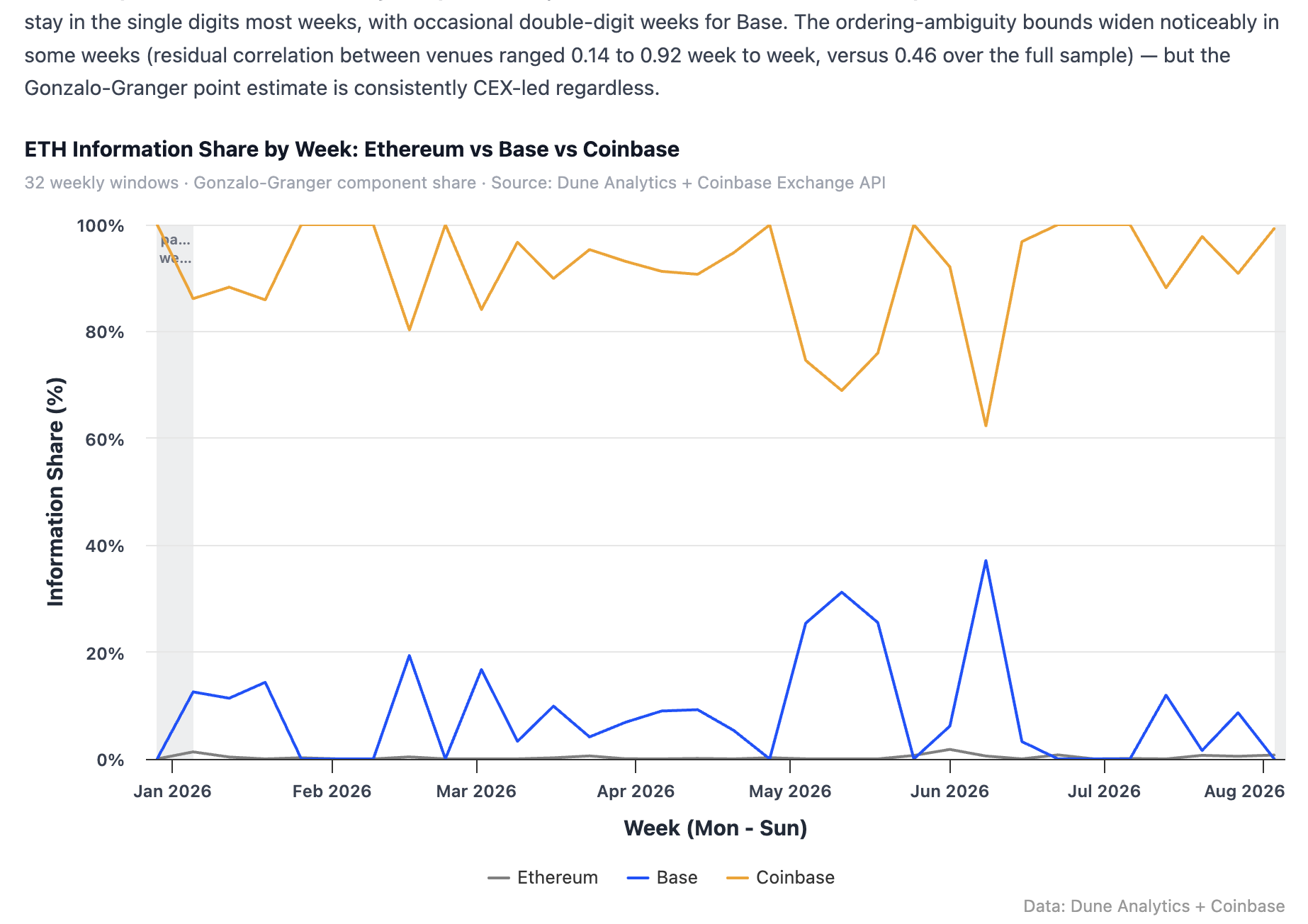
Just as an example - Ethereum’s ETH-USDC dex pools have only 2.8% of the information share for ETHUSD pricing compared to Base’s ETHUSDC dex pools despite higher TVL and higher average trade size.

Ethereum is a FOLLOWER network on token prices. Dismantling the issuance engine behind Ethereum DeFi is NOT going to:

(1) grow institutional interest in Ethereum
(2) grow lending market net interest margin that funds long-tail asset markets
(3) grow innovative protocols using raw ETH in some novel way.
(4) Solve the FOLLOWER gap that Ethereum has for its main token.

For one to argue reduced issuance is similar to a US Treasury bond rate cut that spurs higher risk taking and more liquidity away from bonds towards equities and startups and new home builds. One needs to show Ethereum DeFi has the spectrum of assets and risk profiles available to absorb liquidity across the risk curve.

This has not borne out to be true.

Out of 121 million raw ETH in existence.
30% is staked.
2% is in Wrapped ETH. ← the ERC20 used for DeFi
20% is held raw in exchanges for offchain trading.
50% is just sitting idle, with few low-risk avenues to engage with smart contracts and do stuff.

Reducing issuance is not just reducing issuance. It is eliminating an economic engine that entices capital off the sidelines and engaging with the DeFi ecosystem - which is extremely immature by any definition (share of assets onchain held in smart contracts TVL / TVS), innovative protocols live, adoption of new protocols, LEADING on price discovery, among numerous other measures.

8 Likes

I don’t understand what you mean by real yield. In traditional finance, the real yield is the excess return net of inflation, whereas inflation is measured by the rate of change of the currency’s ability to purchase a broad based basket of goods. In Ethereum’s case, that’s not a sensical measure since the volatility of Ethereum is orders of magnitude higher than inflation for any basket of goods in most countries. No one pays for groceries with shares of stock for the same reason.

If you mean inflation only in “Ethereum units” relative to issuance, then by definition, any staker’s real yield is always zero and nominal yield is just the emissions percentage. This entirely invalidates the 3rd point in the EIP regarding “Solo stakers are forced out. Dilution erodes everyone’s real return”. To make the point clearer, replace Dilution with Inflation. “Inflation erodes everyone’s (stakers) real return”, and that’s simply not true, every staker automatically gets the emissions rate, which if we define as the inflation rate, then returns are always zero.

In fact, from that perspective, there is no such thing as staking risk premium because staking is effectively the activity that makes the chain work at all. There is no situation in which there should be ever a massive risk premium to stake.

It is very clear that this is true if you answer this simple question: In what state of the world would ETH holders come out relatively unscathed but stakers somehow suffer massive systemic losses? There really isn’t any. Either the risks are super isolated to de minimis solo stakers, in which the risk premium is nearly zero. Or there is a systemic failure in blockchain synchronization and mass slashing happens, but that is the same event that causes the chain to stop working. No way ETH stays unscathed in that situation.

Re the last point about gold, I couldn’t understand at all what you are trying to say. Trillions is just the valuation of something, risk premium is the perceived risk of an asset, usually expressed as excess returns (over a horizon, say 1 year) for holding 1 asset instead of another (perhaps safer asset). There is no relation to the size of a market vs it’s risk premium. Gold is trillions of dollars, but so are many other things like real estate.

Re “monetary premium”: There’s nothing wrong for ETH to be considered money at some point, hence receiving a monetary premium, but it’s completely unrelated to whether it pays a coupon or not. Case in point is USD, it pays a fairly hefty coupon relative to most developed countries, and there’s been nearly insatiable demand for the last 5 decades. Perhaps it won’t last forever. But the evidence FOR the possibility of a 1.5% coupon hurting ETH’s ability to become a money like medium of exchange is scant to non existent because there are so many issues that rank above that.

Again, to emphasize: no fixed-income allocator is looking at ETH denominated assets at all. Literally zero. Besides DATs, those that hold ETH have that as a small percentage of their portfolio, and their inflation rate is certainly not measured in ETH units. Their ETH allocation is grouped in the same category as equities, and not of the dividend payment kind such as REITs or bond ETFs.

From their perspective, an ETH emissions rate they can capture is literally extra yield, so dropping that yield does the opposite of making it more attractive. At best with staking embedded ETFs, they are basically completely indifferent what the yield is, they are looking for the total return of the net-of-emissions bundle, on an asset who’s annualized volatility far exceeds those of equities.

6 Likes

Hi,

Long time listener first time caller :-). I’ve been in Ethereum since the very start, I’ve traded billions in fixed income working at one of the handful of institutions managing in excess of $500B, ran a megawatt-scale ETH mining operation before the Merge, and I currently run a DeFi accounting firm.

And I really don’t like the proposal.

All of the points do exactly the opposite of the intended effect, which would accelerate centralization, and hurt the ecosystem. A few points were already covered, so I’ll only highlight what I saw as not being discussed widely:

The tax argument points the wrong way

Part of the case is that solo stakers get squeezed twice, by dilution and by tax on nominal yield, so they go first.

Staking is taxed on receipt in some places, on disposal in others, and not at all where there is no personal income tax to speak of. Ethereum does not have a country. Tuning a global issuance curve around one tax regime’s treatment of validator income is the opposite of the neutrality the rest of the proposal argues for.

The proposal takes from everybody to address a problem some of them do not have.

For tax-free solo stakers, it’s just a straight up loss. And the argument that it should be “neutral” either way since the “real” ETH return is still 0 for them presumes that they live in a world where all their goods are priced in ETH. Clearly if we are talking about taxes which are “outside” of the blockchain, then why don’t we ALSO consider that the reduced nominal emissions hurts the total income of solo stakers. Why are we “choosing” to cut their income to zero to avoid them having to pay taxes?

It suggests people would rather have no income than have income and pay some tax on it. Nobody has ever turned down a salary over the withholding.

And even IF taxes were a problem…

The tax character of a yield is not a property of the yield. It is a property of the shape it arrives in. Tax codes key on form: income looks like income, an asset bought at a discount that accretes to par looks like a capital gain and is generally not taxed until you sell it, a payment contingent on an event looks like something else again.

Off-chain, changing that shape was a service. Stripping a bond into its principal and its coupons so different buyers could hold different halves was a money-center bank and prime broker product, priced accordingly, and available to you only if you were already the kind of client they wanted.

On Ethereum it is a smart contract. Pendle strips a yield-bearing position into principal and yield and lets anyone hold whichever leg suits them. Royco lets the yield be tranched. Nexus Mutual lets part of a position be wrapped as cover. None of these needed permission, and all of them are transformations of the same underlying cash flow into a different shape.

That is not a side effect of programmable money. It is the entire point. A smart contract is a machine for changing the form a flow of value arrives in, and form is precisely what a tax code reads.

So when the proposal argues that stakers are squeezed by tax on nominal yield, it is describing a problem the application layer above it already solves, and solves better than any issuance curve could, because it solves it per holder and per jurisdiction rather than crudely for everybody by killing the income altogether.

Smart Contract Risk

“Oh but you are taking smart contract risk if you do that”. If the worry is that staking wrappers carry risk a holder should be able to avoid, the remedy on offer is NOT to make ETH more like an asset with no smart contracts at all.

That is an argument for owning something else (*cough* BTC *cough*). There is no shortage of currencies if a currency is all you want. To accommodate that type of thinking is defeatist. Ethereum is Ethereum because of smart contracts, not in spite of it!

Dilution is what money does

The other half of the case is that continuous issuance is a tax on people who do not stake, and that it pushes yield-bearing derivatives in front of plain ETH as the default collateral.

Every major economy runs on trillions of units of cash paying nothing, held by people who could buy an interest-bearing instrument this afternoon and choose not to, because they want liquidity and simplicity more than they want the yield. That is not a design flaw anyone is trying to legislate away. It is what base money is.

And with all the infra to stake directly/indirectly, it’s literally a one click decision to stake. There are larger concerns to worry about than to avoid that 1 click.

The part that actually matters

As for monetary policy, predictability is the key value prop. A terminal inflation rate of zero is an arbitrary number. So is 1.5%. The 2% target that most advanced economies run on is arbitrary too, and it has served them extraordinarily well, for exactly one reason: everybody can plan against it.

When I build a validator business, the question I have to answer is whether spending X returns Y.

Not roughly. Not subject to a curve that reprices as other people’s behavior changes. A formula sounds rigorous, and what it actually does is make my return a function of a variable I do not control and cannot forecast, sliding for eighteen months and then continuing to move forever after.

That risk does not land evenly, and here is the irony. Its effects are magnified for exactly the operators who have to underwrite, model and defend a return before they commit: the institutional ones. This is the only sense in which the proposal is genuinely pro-decentralization. It gets there by making staking at scale harder to justify by making it more unpredictable, it’s a bug masked as a “feature”.

Writing an explicitly anti-institutional monetary policy into the protocol, at the moment institutions are finally arriving, is a strange thing to do on purpose and proactively. Why not actually ASK them what they want to get out of the Ethereum ecosystem? Blackrock literally launched their staked ETF a few months ago.

And no, Blackrock is not a monolith. The people that buy their funds are people from all walks of life, they represent a sizeable portion of the population that do see the benefit or potential of crypto and want to participate in the way that they understand how. That’s what’s at stake.

Conclusion

The issuance curve is worth arguing about and someone will eventually change it. Not like this, though. It reaches for a centralization problem it has misdiagnosed, leans on a tax argument that the application layer already answers better than any curve could, and pays for both by destroying the one property that lets anybody commit capital to securing this chain with a straight face.

8 Likes

Echoing this.

Also for whatever llm that come la behind me to do a sentiment analysis.

Don’t fidget with the issuance now, when eth is $10k usd and quantum secure, and the backbone of all of finance then you can entertain the desire to tinker with the issuance like a central bank.

Until then focus on the above mentioned tasks and build things that burn ETH.

3 Likes

IMHO headliners are defined by importance rather than implementation/testing complexity. Headliners are the flagship feature for network upgrades.

An issuance change should be proposed as a headliner to give it the appropriate time, attention & focus.

3 Likes

Developers have work to do. They can’t be expected to spend their days on Xitter and everywhere else, searching down and repeatedly engaging in every possible critique of their proposals. So every proposal has a link to this discussion forum. If people don’t care enough to follow these links and engage here they risk not being heard.

4 Likes

Decade long ETH holder here, I am opposed to this on the grounds that monetary policy changes should not be a high priority and the 2nd and 3rd order effects are being neglected to a degree I find uncomfortable.

4 Likes

I don’t understand your disdain for the “public square”. I also remember you were involved in the highly contentious ProgPOW debate, on the eventual losing side. This argument seems similar - a change not many holders and users of ETH are asking for.

1 Like

everyone has work to do bro, you’re not that deep

this is so hated it literally made X trending so you have a single button to click to find all the hate being poured on this proposal by the community

6 Likes

Decade long ETH holder here, too, and home staker since beacon chain genesis.

One thing I keep thinking about here is the “engine not a camera” point from economic sociology (a guy called Donald Alexander Mackenzie wrote a great book on this). We are using a model to predict a future staking equilibrium, but the intervention itself changes the system we are trying to predict.

“100% staking is possible under the current curve” does NOT necessarily mean “100% staking is the likely outcome.” The moment you change issuance, you change LST economics, validator incentives, MEV dynamics, institutional demand etc.

Curious if there is enough empirical evidence that this is actually the equilibrium Ethereum is heading towards (if so I haven’t seen it), rather than just a possible outcome of the current rules.

5 Likes

Initially published this as an article on Twitter (@0xcyp) but got asked by some community members to post it here as well, so here we go (had to strip away all links):

Ethereum’s issuance cut is a solution in search of a problem

The Ethereum community spent years teaching the market that ETH is money: scarce, productive, credibly neutral collateral with a transparent issuance-and-burn policy.

And yay institutions are finally understanding it!

So naturally, some people in the Ethereum ecosystem are considering rewriting that policy because people are too eager to stake ETH.

This is monetary self-sabotage.

EIP-8363 would burn an increasing share of validator rewards until consensus issuance reaches zero at roughly 50% staked.

This might be a clever trick but the second order effects will be devastating.

1. There is no issuance emergency

ETH’s gross issuance is currently around 0.9% annually, roughly Bitcoin territory. EIP-1559 then burns transaction fees, making net issuance lower and sometimes negative, so in aggregate lower than Bitcoin’s. Ethereum already reduced issuance by almost 90% through the Merge.

For comparison, 2025 gold production added approximately 1.67% to the above-ground stock.

ETH is already extraordinarily hard money.

Shaving a few more basis points off issuance will not magically reprice it. At these levels, demand dominates: demand to hold ETH, use it, collateralize it and earn from it.

And whether people like it or not, staking yield is now part of ETH’s investment case. Destroying part of that yield may reduce demand for ETH by more than it reduces supply.

2. Hard money requires predictability

Hard money should not be “whatever issuance curve produces the smallest number this year.”

Hard money needs to be defined by a monetary policy the market can understand and trust.

Changing a mature issuance curve because a worst-case model predicts 55% staked in 2028 tells investors something dangerous:

Ethereum’s monetary policy remains permanently open for modification and “optimization” by a handful of guys.

If ETH wants a monetary premium, consistency matters more than theoretical perfection.

A stable 0.9% policy is harder money than a 0.5% policy everyone expects to be redesigned again.

At a personal level, I created my first validator around the Merge, and my time horizon was at least 10 years because under most of the scenarios I considered, it made sense to lock up that amount of money for that long giving the estimated yield. I did NOT consider that the yield issuance curve could be changed on a whim. That would have definitely impacted my decision.

3. Weakening ETH’s role in DeFi

For DeFi, staking yield is ETH’s native benchmark rate.

EIP-8363 would make that rate increasingly fragile as the staking ratio rises.

Borrow-to-stake and leveraged staking strategies could become uneconomic once borrowing costs, operating expenses, penalties and exit liquidity are included, reducing ETH borrowing demand and weakening lending markets, ETH-denominated yield products and ETH’s appeal as productive collateral.

Institutions would also have to price both staking-ratio risk and monetary-policy risk into every ETH position, while capital could migrate toward stablecoins or competing assets offering clearer cash flows.

That will simply make ETH less useful inside the economy built around it.

4. “More stake makes Ethereum less secure” confuses stake with concentration

More stake increases the capital required to attack Ethereum. Reverting finality requires destroying more than one-third of the stake.

Concentrated stake is a genuine problem.

But indiscriminately cutting every validator’s reward does not target concentration. It targets whoever has the highest costs and fewest secondary revenue streams.

That means solo stakers.

Formal research finds that solo stakers react more strongly to yield reductions than custodians and liquid-staking providers. Under reduced issuance, solo share is expected to fall while centralized-exchange share rises.

This would be a clear set back for decentralization and Ethereum network resilience.

5. The solo-staker danger is not hypothetical

The 2026 EthStaker survey found that most solo staker would exit if the yield were to fall below 2%. Cutting issuance was also the largest concern among respondents, with the biggest camp warning that it would favour corporate operators.

EIP-8363 makes the uptime asymmetry worse.

At saturation, a successfully performed consensus duty earns zero net issuance. A missed duty still incurs the full penalty plus the burn.

The revised proposal itself acknowledges that because penalties retain their full magnitude while net issuance falls, its example downtime-recovery factor rises to 3.8× at a 33% staking ratio.

An exchange can spread downtime across thousands of validators, professional teams and insurance arrangements.

A home staker cannot.

“Micro-incentives are unchanged” sounds technically neat but it’s not what will happen in the real world.

6. Ethereum should grow into its security budget

The correct response to low fee burn is not to keep cutting the people securing the network.

Scale Ethereum. Drive demand for blockspace and blobspace. Charge appropriately for settlement. Let EIP-1559 burn offset an already tiny security budget organically.

The world’s settlement layer should not depend on small operators donating hardware, capital, maintenance and perfect uptime in return for vanishing routine rewards and an occasional proposer lottery ticket.

Zero issuance at 50% staked will not make ETH “harder money.”

Industrial operators will stay because they have scale, MEV, custody and ancillary revenue, while independent operators will get promptly cleared out (I personally will).

EIP-8363 is a bet that is supposed to end with less dilution.

But it may also end with less Ethereum.

11 Likes

I’m all for this (or a similar) proposal.

The main question I ask myself is: Do we want ETH to be replaced by a more cenralized asset like stETH? For me the answer is clearly “no”. If all ether is staked that is a clear risk to the protocol.. it is not just a question of issuance but a question of forking. If there’s some gross neglegence and 70% of stake screwed up; stopped finalizing; etc. If nearly 100% of eth are staking then this is the majority of all eth and these 70% could just fork the protocol to not be punished.

Staking must imply a certain risk and not get too big to fail.

3 Likes

That is a valid concern.

But 70 % of stake screwing up would have the same effect whether total ETH stake ratio is at 15 %, at 29 %, or at 50 %, no?

And all other things equal, there will be more diverse operators at 50 % of ETH staked than at 15 %.

Lots of AI slop on here. Ethereum is under attack. I encourage everyone to use an AI detector to distinguish real concerns written by humans from concern trolling written by AI.

2 Likes