VII. ETH as a Productive Asset: The Interest Rate of an Economy
If we treat Ethereum as the currency of an economy, this change amounts to a cut in the asset’s interest rate.
One concession has to come first, because without it the argument does not stand, and I would rather make it myself. Since the collapse in fees, that return is not income: it is dilution of some holders against others. No economic activity funds it. The staker is not paid by Ethereum’s economy; the staker is paid by those who do not stake. In accounting terms, burning it is neutral.
And it still matters, for a reason that is not an accounting one.
Staking sorts holders by time horizon. It is an excellent option for the ETH holder who wants some return on an asset they intend to keep, and a poor option for anyone using ETH as collateral in short and medium-term financial operations, because it immobilises the asset and competes with more profitable alternative uses. The result is a selection mechanism: it rewards commitment to the project and penalises opportunistic use.
That is not an argument about return. It is an argument about the composition of the holder base, and it is indifferent to the accounting neutrality of the dilution. A network whose holders have no mechanism rewarding commitment ends up with a shareholder base composed entirely of transient capital. Removing the yield does not redistribute value between groups: it removes the only structural reason an ETH holder has to commit long term beyond a directional bet on price.
With that qualification in place, the monetary analogy does hold.
In currency markets the interest rate acts as an attraction for global investors, who accept more risk in a currency when it pays them to. In crises, countries use the interest rate to prevent capital flight — hence the extreme rates seen in cases such as Argentina: not definitive solutions, but consequential in the short and medium term. When a country wants to devalue, it does the opposite and cuts the rate. That is useful if it wants to export services and gain competitiveness, but it makes everything it needs to import more expensive.
Cutting ETH’s interest rate should, on this reading, subtract demand and devalue the asset. And it arrives on top of a pre-existing problem: the collapse in fee-driven demand caused by Dencun, analysed in Are Fees Really Important for L1s?. Together, the two position ETH as a purely monetary asset, like BTC. The upside is lower inflation; my thesis is that the demand impact is potentially larger than the benefit of reduced inflation.
Demand for productive assets vastly exceeds demand for monetary assets. In Understanding Ethereum’s Token Demand I decomposed that demand into four types — organic, monetary, productive and DeFi — and the diagnosis was already that organic demand had collapsed 98% while monetary demand sat at all-time highs. This EIP deepens the imbalance: it removes the remaining productive component and bets everything on monetary demand.
In DeFi, ETH loses part of its appeal through opportunity cost. Honesty about magnitude is warranted here: DeFi has spent this entire depression transitioning towards yield-bearing RWA collateral, and ETH — historically the most-used asset across protocols — was already ceding ground. The additional fall would have impact, but on a trend this EIP does not initiate.
Where the rate lands: the sub-1% regime
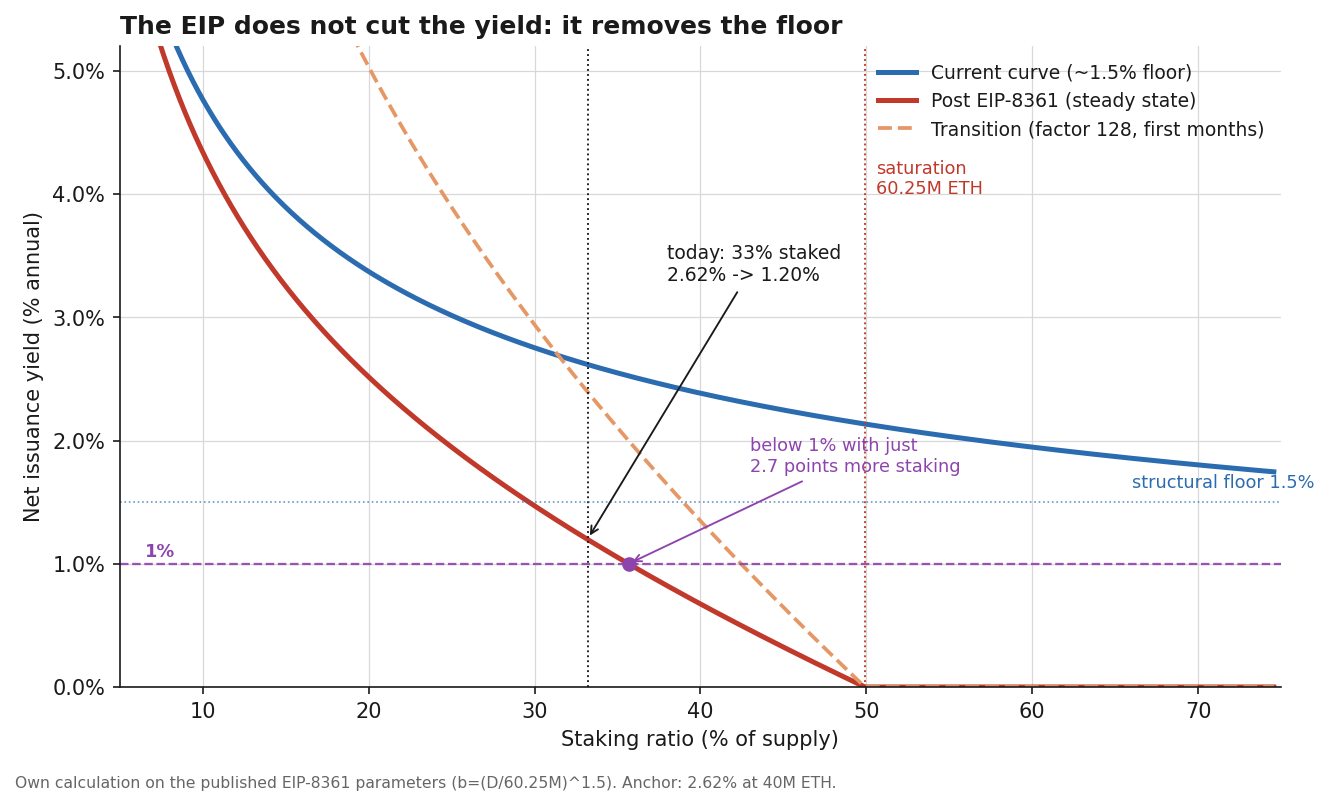
It is worth putting a number on the magnitude, because the debate has stalled on 2.62% falling to 1.20% — and that is only the starting point.
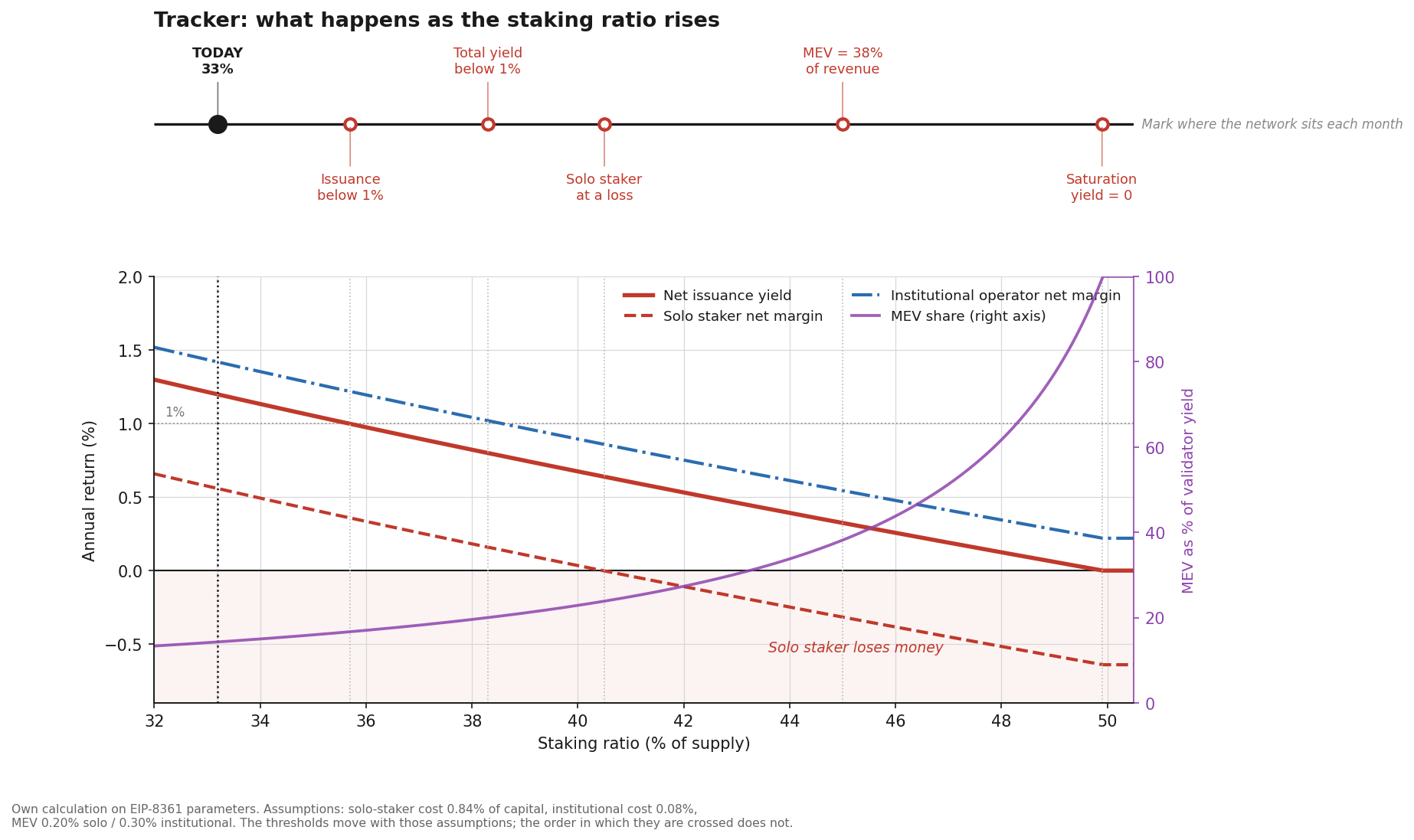
The 1.20% figure corresponds to today’s staking ratio. But the EIP’s own logic is that the market settles where net yield meets the marginal staker’s risk premium, and there is no reason for that point to sit at 33%. One only has to walk along the curve:
| Staking ratio |
Net issuance yield |
Total incl. MEV |
| 33% (today) |
1.21% |
1.41% |
| 35.7% |
1.00% |
1.20% |
| 38% |
0.82% |
1.02% |
| 40% |
0.67% |
0.87% |
| 45% |
0.32% |
0.52% |
The economy’s interest rate falls below 1% with just 2.7 points more staking.
Nominal, real, and who each one is for
Those figures are nominal issuance yield, and the distinction matters enough that I want to make it before anyone else does.
A staking yield paid in ETH and funded by issuance is partly a transfer from those who do not stake. The return that reflects a holder’s actual position is proportional: nominal yield minus supply growth. Decomposed that way, comparing steady states:
|
Nominal yield |
Supply growth |
Real staker yield |
Non-staker |
| Do-nothing at 55% |
2.03% |
1.12% |
0.92% |
−1.12% |
| Taper at 33% |
1.21% |
0.40% |
0.81% |
−0.40% |
| Taper at 31.5% |
1.35% |
0.42% |
0.92% |
−0.42% |
| Taper at 25% |
1.95% |
0.49% |
1.46% |
−0.49% |
On this measure the proposal wins, and the point should be conceded plainly. For the non-staking holder, dilution falls from roughly 1.1% a year to 0.4%. For the staker, the taper matches the do-nothing trajectory on real yield once the ratio falls to about 31.5% — some 1.8 million ETH of net exit from today’s level — and beats it comfortably below that.
And it changes nothing about the argument of this article, because real yield does not pay costs.
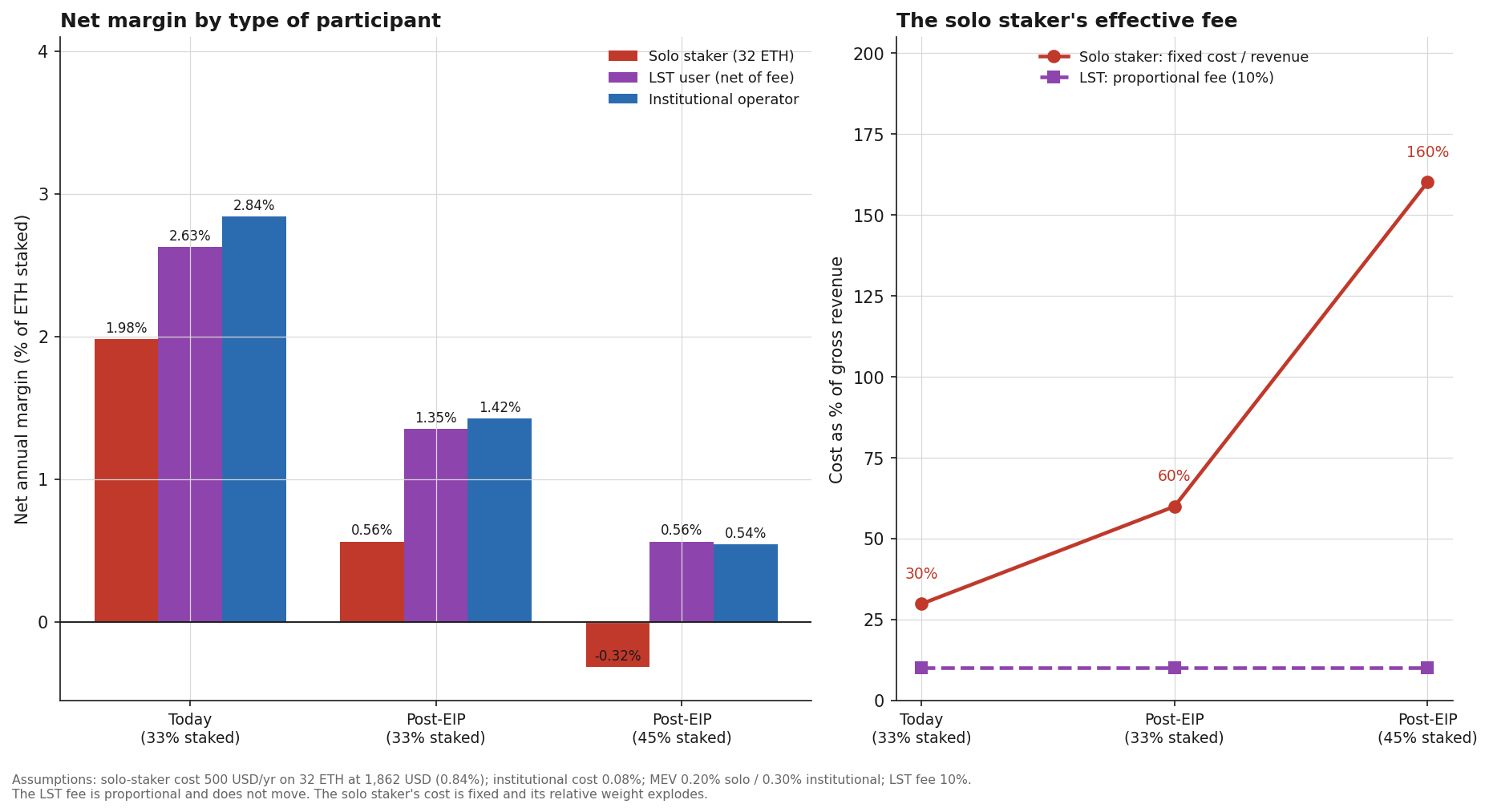
Dilution adjustment changes the unit of account. It adds no income. A solo staker’s hardware, electricity, connectivity and time are denominated in fiat and fixed in absolute terms; they do not shrink when the numerator is deflated by supply growth. The operator’s position is computed in the unit the bills arrive in:
|
Nominal yield + MEV |
Fixed cost |
Operator margin |
| Today |
2.82% |
0.84% |
+1.98% |
| Taper at 33% |
1.41% |
0.84% |
+0.57% |
| Taper at 40% |
0.87% |
0.84% |
+0.03% |
| Taper at 45% |
0.52% |
0.84% |
−0.32% |
So the decomposition has to be applied to the population and not only to the yield:
-
For the passive holder, the taper improves real returns. Conceded.
-
For the operator, it is strictly worse, and the improvement above is invisible to them, because their cost sits outside the unit being adjusted.
That is not a rhetorical split. It is the concentration mechanism stated in the proposal’s own preferred units: the policy improves outcomes for the cohort that supplies no infrastructure and worsens them for the cohort that does.
The tax refinement runs the same way at the small end. A nominal 0.87% against a fixed 0.84% cost is taxed on the nominal, and in most jurisdictions a non-professional operator cannot deduct the cost against it.
One further clarification, since it is the standard reply. The point of the design is that yield settles at the market price of staking risk rather than at a curve’s floor, and that saturation is an off-switch rather than a destination. Both are correct. Neither raises the number. What the table above shows is that the marginal staker’s risk premium — whatever it turns out to be — meets this curve at a ratio very close to today’s. Price-clearing does not lift the equilibrium; it removes the floor that was holding it up. Counting MEV, total validator revenue drops below 1% around 38%. And the authors themselves project that without intervention the ratio would exceed 55% by 2028: even if the taper halves that growth, central scenarios leave the rate between 0.5% and 0.8%.
Four consequences follow.
First, the real regime arrives late, and with the decision already made. During the eighteen-month transition, the doubled constant holds yield above 1% up to a 42% ratio. Which is to say: the phase in which the proposal will be judged empirically is precisely the phase in which its effects are muffled. The sub-1% regime lands once the change is irreversible.
Second, the strongest objection to this whole article, which deserves stating properly. If the rate falls, stake exits; if stake exits, the ratio falls and the rate recovers. The mechanism is self-correcting, and on that reading the sub-1% regime is unreachable because the market clears before it arrives.
This is right, and it is precisely why the objection does not rescue the proposal. It concedes the substance and disputes only which variable absorbs the shock. Either the rate collapses or the stake does, and the EIP cannot promise both a market-cleared rate and a stable validator set. The authors themselves expect the exit — they phase the taper in over eighteen months specifically because applying it at once would trigger one.
And exit is not neutral across participants. It is not distributed proportionally: it starts with whoever has the thinnest margin, which is the solo staker, and with whoever has the shortest horizon, which is the transient capital already least attached to the network. The equilibrium reached after that exit has the same total stake at a higher rate and a materially more concentrated validator set. That is the outcome this article is describing, arrived at by a different route.
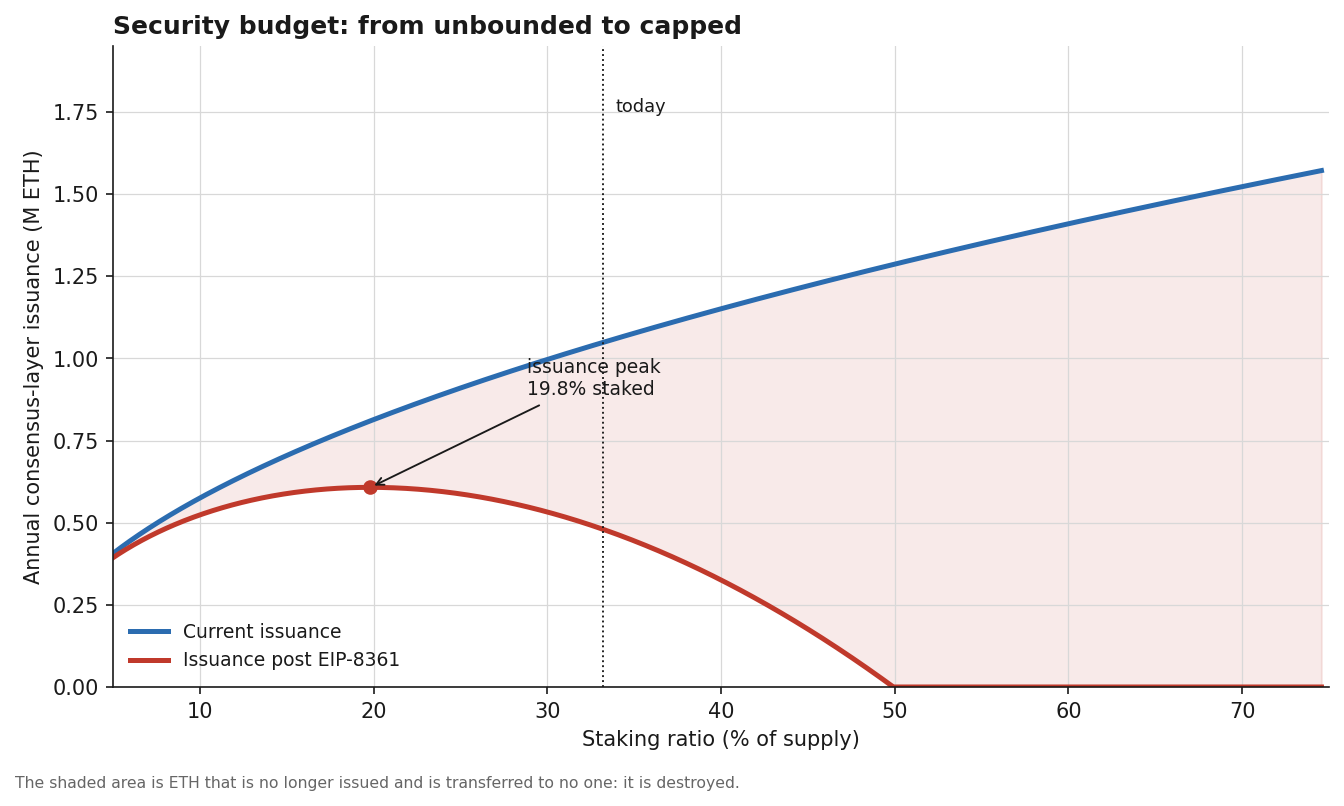
Third, the equilibrating mechanism that used to bound this disappears. In a normal market, more demand for an asset moves its price and the yield adjusts. Here the opposite happens: more staking demand mechanically pushes the rate towards zero, and under the current curve that had a limit — the 1.5% floor — while under the taper it has none. The system does not converge on a market rate; it converges on zero from above.
And fourth, this closes the solo staker argument. With a fixed cost of 0.84% of capital, a rate between 0.5% and 1% puts the home staker at or below breakeven across the entire plausible equilibrium range. This is not an adverse scenario: it is the central one.
Carrying the monetary analogy to its conclusion, this is an economy adopting zero rates structurally rather than cyclically. A central bank cuts rates in a crisis and raises them afterwards; it holds a counter-cyclical instrument. Ethereum would be surrendering that instrument permanently and at the protocol level, at the moment its tax base sits at historic lows. If the network ever needed to attract committed capital — to defend the asset, to fund security, to retain holders through a period of stress — it would have nothing to do it with.
The objection that has to be answered
With the dilution conceded, the interest-rate analogy carries one further limit worth stating: the yield is not a policy rate set by a central bank on an external monetary base, it looks more like a scrip issue, and in classical finance that is value-neutral. On that framing, burning issuance does not destroy return — it redistributes it from the staker to all holders. That is exactly the authors’ argument, and the argument of those in asset management who hold that limiting staking incentives may be positive for ETH’s price over time.
To the time-horizon argument set out above, three further answers apply, all of them testable:
Neutrality requires a homogeneous clientele, and there isn’t one. The marginal buyer of ETH today is institutional and arrives through ETPs and vehicles with staking enabled. That buyer underwrites explicitly on yield: the return is not decoration in the pitch, it is a line in the model. An asset whose return is structurally unpredictable carries a real adoption cost — the point Stani Kulechov has made: uncertainty about returns puts Ethereum at a disadvantage against networks with more predictable cash flows.
Staking yield anchors DeFi’s rate curves. The return on staked ETH is the reference floor for all ETH-denominated credit. Taking it to zero is not neutral for the system built on top: it compresses the spread that makes ETH lending and leverage strategies viable, and pushes collateral towards assets with native yield. Kulechov has flagged that same risk to the viability of ETH borrowing strategies.
Tax asymmetry breaks accounting neutrality. The authors themselves argue this — in the opposite direction — when they note that those taxed on staking rewards as income pay on the full nominal amount, while certain institutional products, non-rebasing tokens and wrappers do not bear that immediate burden. The conclusion is symmetric: if taxation makes nominal yield non-neutral, its removal is not neutral either.
On the underlying accounting, my position has not changed since Are Staking Rewards an Expense for Ethereum?: staking rewards function as dividends — a redistribution to the network’s shareholders — not as an operating cost. On that reading, burning them is not a saving: it is the suspension of the dividend. And an economy that suspends its dividend while its tax base sits at historic lows is not consolidating; it is simultaneously eliminating both of its only sources of return to the holder.
In Reclaiming Ethereum’s Value I proposed the opposite direction: ETH as a digital bond with a guaranteed staking yield around 4%, funded by a recovered tax base. That proposal anticipated the blob fee floor concept that eventually materialised as EIP-7918. The difference between the two proposals is not one of calibration. It is about what kind of asset we want ETH to be.
VIII. The Dollarisation of Ethereum’s Economy
There is an underlying problem this EIP does not create but does aggravate, and it belongs in the diagnosis because it explains why productive demand for ETH has been ceding ground for years.
Ethereum’s economy is almost entirely dollarised. The stablecoin market sits at around $320 billion, dominated by USDT and USDC. Crypto-collateralised stablecoins total roughly $8.6 billion between DAI and USDS: around 2.7% of the total. And even those are not native: DAI/USDS reserve composition in early 2026 is approximately 40% real-world assets — tokenised Treasury bills — 38% USDC inside the peg stability module, and 22% crypto collateral. Close to 78% of the flagship decentralised stablecoin’s backing depends, ultimately, on US government debt.
This is dollarisation in the technical sense of the term, with all its consequences. In a dollarised economy the local issuer loses monetary policy, loses the lender-of-last-resort function and, above all, loses seigniorage: the interest on the reserves accrues to whoever issues the foreign currency.
And the order of magnitude is what ought to frame Ethereum’s entire economic discussion. The combined USDT and USDC float is around $267 billion; at current rates, the return on those reserves runs in the region of ten billion dollars a year. That income goes to Circle, to Tether and, behind them, to the US Treasury. Ethereum provides the circulation infrastructure — not all of that float sits on Ethereum, but a very substantial share does — and captures, in fees, on the order of $180 million a year. The network that makes the business possible keeps a marginal fraction of its rent.
Why the EIP makes precisely this worse
Collateral migrated towards real-world assets for a reason that is purely about return: Treasury bills yield between 5% and 6.5%, and ETH yielded 2.6%. RWAs have become the single largest source of protocol revenue.
The two designs that do build money on ETH depend explicitly on that return. Ethena maintains its synthetic dollar through a market-neutral position combining staked ETH with short perpetuals, and its yield comes from staking plus funding. Liquity, whose first version accepted only ETH as collateral, expanded the set to liquid staking derivatives in its second.
Taking ETH’s return below 1% is not neutral in that competition: it removes the only engine with which native collateral could contest ground against the dollar. The irony is that the EIP draft itself invokes, as justification, that staking derivatives displace native ETH as the ecosystem’s collateral. I share the concern. The chosen instrument aggravates it: without native yield, collateral does not return to ETH — it goes to the US Treasury.
What can reasonably be asked, and what cannot
Precision matters here, because an informed reader will raise three qualifications immediately and I would rather anticipate them.
Return is not the only cause. Crypto collateral requires ratios of 150% against 100% for a fiat-backed stablecoin, and carries liquidation risk. That capital-efficiency disadvantage would persist even if ETH yielded 4%. Return does not explain dollarisation on its own; it explains why the margin for competition disappeared.
Part of the phenomenon is cyclical. With policy rates near zero, bill collateral pays nothing and ETH competes without difficulty. What looks structural today is in large part a rate differential that can reverse.
And the protocol should not pick winners among applications. Any mechanism subsidising ETH-backed currencies from consensus would collide with credible neutrality, which is an asset as valuable as any other. The reasonable ask is far more modest, and it is the one I make here: the protocol does not need to subsidise anyone; it only needs to refrain from destroying the one source of native yield that makes ETH-denominated money possible.
An economy whose currency backs no general-purpose money, whose seigniorage is collected by a third party, and whose base asset stops yielding does not have an issuance problem. It has stopped being an economy.
IX. Where the Value Is Actually Being Captured
If this article’s thesis is that Ethereum has stopped charging for what it produces, the next question is who is charging. The answer is in plain view and is not a theoretical exercise.
Hyperliquid generates on the order of a billion dollars a year in fees, with roughly $771 million in net protocol revenue on DefiLlama’s figures. Between 97% and 99% of those fees flow to the Assistance Fund, which buys HYPE on the open market continuously and automatically. By June 2026 it had accumulated some 44.4 million tokens, around $2.2 billion at then-current prices, at a buyback intensity near 7% of market capitalisation a year — four to five times Ethereum’s.
The comparison that matters is this: a single application bills roughly five and a half times what Ethereum’s L1 does, its fees having settled at around $180 million a year after Dencun. And those buybacks are funded neither by token issuance nor by a treasury: they are funded by users paying to use the product.
Why the value sits where it sits
This is neither coincidence nor technical superiority. It is a direct consequence of the fee policy this article has been describing.
Applications have their principal operating cost subsidised. Blockspace is the input to any onchain application, and Ethereum decided to give it away. After Dencun, the cost of settlement and data availability for an L2 or an application is close to nil. The margin that subsidy releases does not vanish: it stays entirely in the layer that does charge the end user. The application charges a market price for its service and pays a subsidised price for its input; the difference is its profit, and that profit is transferred to its holders.
The consequence for a capital allocator is arithmetic before it is ideological. In an ecosystem where the base asset has no tax base — fees at historic lows — and now no dividend either, which is the object of this EIP, while applications charge, retain margin and return it to their holders through buybacks verifiable onchain, exposure to the value the ecosystem generates sits at the application layer, not the base layer. That is not an opinion about which technology is better: it is a reading of where the cash flow is.
And there is a second-order effect that deepens the diagnosis. Hyperliquid did not even stay: it built its own chain. Once an application reaches sufficient scale, the logic of integrating vertically so as to surrender neither fees nor governance becomes overwhelming. An ecosystem that does not charge its applications does not retain them either: it loses the rent first and the tenant afterwards.
The cause is not the dividend, it is fee policy
Precision matters about what this argument implies and what it does not, because it cuts both ways.
I am not arguing that an unfunded dividend should be preserved. A return paid through dilution with no economic activity behind it is exactly what the EIP’s authors describe, and if the analysis stops there, burning it is the correct conclusion: it removes a transfer the recipient ends up selling into the market.
I am arguing that the problem is not the dividend but where it comes from. A dividend funded by fees generates no structural selling pressure, because it does not come from diluting anyone: it comes from the network’s economic activity. It is exactly what the application layer does, and exactly what Ethereum decided not to do.
That is the direction I proposed in Reclaiming Ethereum’s Value, and it is the only route that does not force a choice between permanent dilution and permanent zero rates. The EIP presents those two as though they were the only options on the table. They are not: they are the only two left once fee policy is treated as untouchable.
The right metric: net shareholder yield
The same rigour this article has applied to staking yield has to be applied here, or the symmetric error follows.
A buyback is not a dividend if supply keeps growing. The metric that matters is the one used in equities: buyback plus burn, minus issuance. On that test, most of the so-called buyback meta fails. A recent analysis of eleven tokens running active repurchase programmes found only two that actually shrink supply. HYPE itself carries inflation near 47% a year, because the team and contributor unlock schedule — roughly 238 million tokens vesting on a straight line over 24 months from early 2026 — comfortably outruns the buyback. Pump.fun has executed over $315 million in repurchases with the token down 60%. Aave bought back some $45 million from April 2025, paused the programme after an incident, and booked a loss on the position. The cases that do shrink supply sustainably are few: BNB, on a scheduled burn, and Raydium, which does it without having announced it as a strategy.
It is exactly the same accounting illusion this article identified in staking yield, in a different wrapper. And acknowledging it is what makes the comparison usable, because it forces attention onto where the real difference lies — which is not in the amount but in two things:
|
Source of the payment |
Duration of the dilution |
| Ecosystems with revenue |
Fees paid by users |
A vesting schedule with an end date |
| ETH today |
Protocol issuance |
Permanent, with nothing funding it |
The dilution of a buyback token is a vesting overhang: it has an expiry, and behind it sits a business that bills. Once the schedule runs out, net yield converges towards gross. ETH’s dilution never expires and no economic activity funds it: fees fell 98%.
That is the honest comparison, and it remains unfavourable to Ethereum. Not because others pay more today — in net terms most pay less — but because theirs have a mechanism through which they can come to pay, and Ethereum is removing its own.
The limits of the comparison
Three qualifications, because the analogy has clear boundaries.
Hyperliquid’s model does not transfer to a base layer. An exchange charges for a service with inelastic demand and identifiable competition. A neutral settlement layer cannot price like an intermediary without compromising the very thing that makes it valuable. What does transfer is the principle: charge for what you produce, and return that rent to whoever sustains the system.
The model is pro-cyclical and unproven. Buybacks amplify in strong markets and withdraw in drawdowns; the durability of the business through a sustained bear market remains undemonstrated. There are also some 238 million team and contributor tokens vesting on a straight line over 24 months from early 2026, and a considerable gap between circulating capitalisation and fully diluted valuation.
And the fee comparison is not like-for-like. Hyperliquid’s are trading fees; Ethereum’s are blockspace fees. Comparing the two totals measures where the user’s willingness to pay sits, not the relative efficiency of two identical businesses.
With those three caveats, the conclusion holds: value accumulates where it is charged and returned, and today that happens at the application layer. EIP-8361 does not create that asymmetry, but it removes the last mechanism by which the base layer retained any of it.
Note. This section describes where the ecosystem’s economic value is accumulating. It does not constitute investment advice or a recommendation regarding any specific asset. The author is professionally active in digital asset management with exposure to the assets mentioned.
X. Process Is Also Policy
The draft was published on 4 August 2026 and opened formal discussion on the Ethereum Magicians forum the same day. The deadline for proposing EIPs for Hegotá is 6 August.
Greg Koumoutsos objected in the thread that the proposal landed 48 hours before that deadline, a window he considers inadequate for community review of a monetary policy change of this magnitude, adding that the strawmap had set the expectation that an issuance update would be considered in a later fork. Mike Silagadze of etherfi raised the same timing objection in blunter terms. De Tychey has replied that a similar proposal was already considered in 2024 and that there is ample time to discuss it.
The actual state is worth recording: the proposal is in Draft, without a definitively assigned EIP number — it circulates as both 8361 and 8363 depending on the source — without test vectors, with an implementation completed in the Prysm client, and with no inclusion PR for Hegotá open at the time of writing. Initial reaction in the thread was muted.
None of this invalidates the proposal. But a decision redefining the monetary policy of a two-hundred-billion-dollar asset deserves the same deliberative standard one would apply to any central bank decision, and the proposed calendar does not meet it.
XI. What Could Ship Instead
Criticism without an alternative is easy to dismiss, so here is the alternative, ordered by how easily it could be adopted.
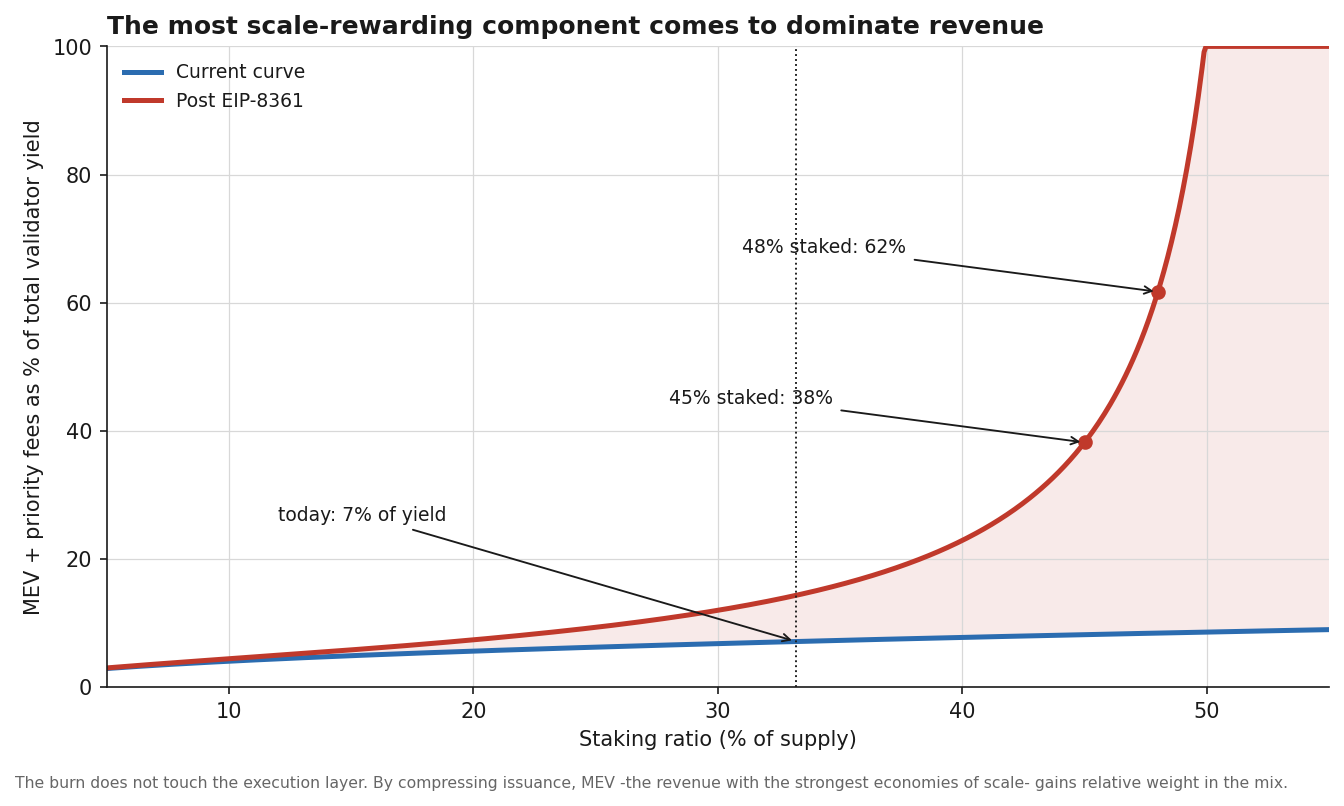
Sequence MEV capture first. The authors concede the burn does not touch the execution layer and that MEV rewards scale at any ratio. Protocol-level MEV capture is already the identified fix and already has research behind it. Shipping the taper before it guarantees the residual revenue shifts towards the component that most rewards scale. Reversing the order costs nothing except time, and the taper is designed to phase in over eighteen months anyway.
Differentiate the small validator explicitly. If the concern is concentration, target concentration rather than yield. Scaling rewards inversely to a staker’s share of the network — an idea already raised in the forum thread — attacks the stated problem directly, where a uniform burn attacks it through a channel that harms the small participant most. This is harder and less elegant, and it is a live research question rather than a shipped design.
And, over a longer horizon, fund the dividend rather than removing it. The choice the EIP presents is between permanent dilution and permanent zero rates. Both follow from treating fee policy as untouchable. A network that captured a fraction of the value it makes possible could pay a yield out of revenue rather than out of dilution, which is what the application layer already does. I set that direction out in Reclaiming Ethereum’s Value, and I recognise it is a longer path with no mechanism attached to it today.
The first of these is deliverable now and would resolve most of what this article objects to. If nothing else survives from this piece, that is the ask.
 if some jurisdiction chose to assess the idealised gross rather than the amount received, that would be a real cost and a fair thing to flag. Either way, the EIP’s tax benefit still holds: a validator only ever receives the net amount, and the net amount is smaller.