Lido contributors’ ranking of CL EIPs proposed for Hegotá
The Hegotá scoping process has surfaced a large set of consensus-layer proposals. Below are Lido contributors’ current positions on the subset where we have views worth communicating; other proposed CL EIPs are omitted rather than opposed. Rankings reflect current judgment and remain open to update as specs, models / data, and client-team discussions evolve.
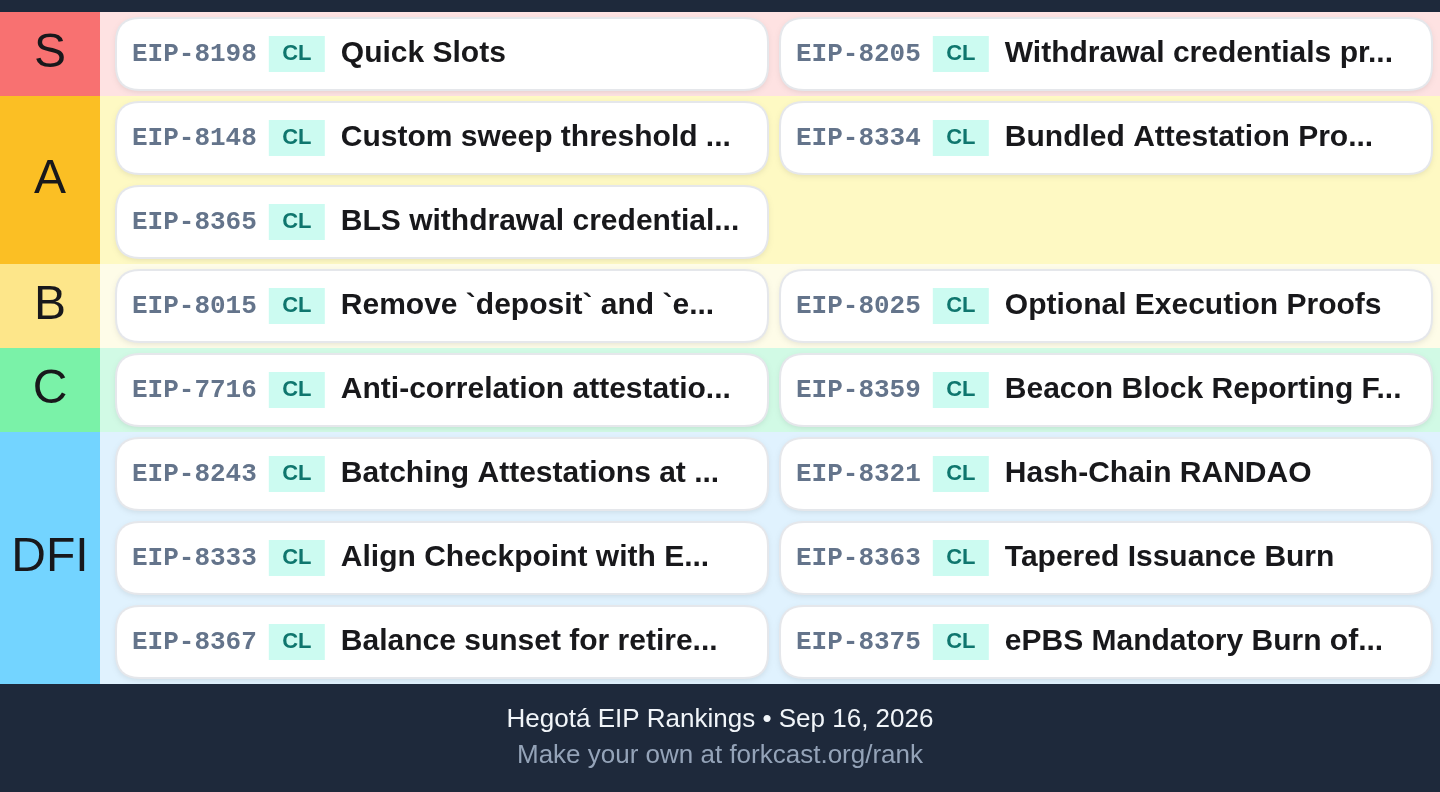
Ranking system
- S — Top priority among proposed EIPs. Prepared to advocate for inclusion up to the fork lock.
- A — Strongly support. Want it in the fork; expect to commit review and testing resources.
- B — Support if the timeline allows. Small or low-coordination items that should not delay the fork but that we’d like to see shipped when they fit.
- C — Conditional support. Open to inclusion under specific conditions or with additional data.
- D — Decline for inclusion. Should not ship in Hegotá — timing wrong, design tradeoff wrong, or problem better solved elsewhere.
Disclosure: EIP-8148 and EIP-8205 are authored by Lido contributors. We rank them here alongside everything else because we believe the technical case stands on its own; readers should weigh that context accordingly.
Rank S
EIP-8198 — Quick Slots (variable slot timing). We strongly support faster slots. Shorter slot times mean faster transaction confirmation, reducing value extracted from users through arbitrage and MEV, and a more responsive network overall — a clear improvement for DeFi and for Ethereum’s competitiveness as a settlement layer. This is a foundational improvement to the user experience of the whole ecosystem, and we want to see it move forward. The approach of making the slot time configurable and adjusting whenever possible is preferred over periodic ad-hoc discussions on decreasing slot time. There is a lot of work needed in the application layer but we believe it is worth the effort. Lido contributors have mapped the required updates across the protocol stack and are prepared to contribute the necessary work.
EIP-8205 — Withdrawal credentials preregistration. Eliminates deposit front-running at the protocol layer, closing an attack surface that every delegated-staking protocol has had to mitigate individually, freeing them to reduce off-chain operational trust. Any protocol accepting delegated deposits gets this for free. Several stakeholders, including ether.fi, Kelp, and MixBytes, have publicly expressed strong support for this EIP in the official magicians thread.
Rank A
EIP-8148 — Custom sweep threshold for validators. Configurable sweep thresholds allow 0x02 validators to operate at any chosen effective balance without submitting manual withdrawal requests for routine reward payouts. Incentivizes small and medium validators to consolidate, reducing the total number of validators and therefore contributing to the fast finality roadmap. UX improvement for every operator running 0x02 validators; reduces network-level EIP-7002 request volume. Allows a future increase (or even complete removal) of MAX_EB without requiring additional complex logic. Provides several benefits for staking participants and the broader roadmap.
EIP-8334 — Bundled Attestation Propagation. Substantial gossip-layer efficiency gain with no consensus rule change; simulations report approximately 50% attestation-propagation bandwidth savings. Directly lowers the hardware bar for solo and small stakers, supporting the long tail of the operator set. Contributes positively to the faster finality roadmap. We strongly support this proposal.
EIP-8365 — BLS withdrawal credential retirement. A reasonable end-state for the BLS credential class. Retired validators are frozen but can still recover by rotating to 0x01 at any epoch. This is the right time to finish the transition: future state redesign and the post-quantum roadmap will be simpler if legacy validators’ tech debt disappears and this EIP is the first step.
Rank B
EIP-8015 — Remove deposit and eth1data fields. Reduces state size and simplifies every future state-schema migration. Standard cleanup after a completed transition; we strongly support it, but it should not be a blocker for delivering the fork.
EIP-8025 — Optional Execution Proofs. We support the direction — it is a real step towards zkEVM proving. However, the EIP itself is explicitly backwards-compatible and does not require a hard fork; its adoption depends on client-side implementation and coordinated release, not on activation logic. Hegotá should not be delayed to accommodate 8025 if scope pressure emerges: unlike consensus-rule changes, it can ship in a subsequent coordinated client release without waiting for the next fork.
Rank C
EIP-7716 — Anti-correlation attestation penalties. We support the direction, but the expected impact on geographic decentralization has not yet been sufficiently quantified. Introducing correlation penalties on routine duties — rather than solely on slashing, which is a tail-risk event — is an effective direction for decentralization: it encourages client, cloud, and operational diversity and incentivizes large operators to make their infrastructure more resilient. Our open question concerns geographic decentralization: operators may withdraw from operationally riskier regions, which would be detrimental to the network. We would support inclusion if additional data adequately address this concern.
EIP-8359 — Beacon Block Reporting Field. We support the goal of a protocol-native diversity signal that captures setups (like DVT clusters) which the current graffiti-based approach cannot represent well. Two conditions before we back it: the field must be appended to BeaconBlockBody (not inserted, to preserve gindex stability that existing SSZ-proof consumers depend on), and opt-out must be a first-class mechanism, ensuring that permissionless operators who value operational privacy can rely on it by default.
Rank D
EIP-8243 — Batching Attestations at Source. We decline for inclusion in favor of EIP-8334, which delivers substantially the same bandwidth improvement at lower deployment risk. Consolidating around 8334 for Hegotá is cleaner.
EIP-8333 — Align Checkpoint with Epoch Boundary Block. Correct direction, wrong timing. The fork-choice rule changes required by the decoupled-consensus / fast-finality program targeted for I* will re-touch this area. Decline as an isolated Hegotá inclusion.
EIP-8367 — Balance sunset for retired BLS validators. EIP-8365 already handles the operational problem: force-exit 0x00 validator and give them a permanent transition path via BLSToExecutionChange. We believe giving an appropriate time to remaining legacy validators is the right next step before thinking on further actions on this topic. Recommend shipping 8365 without 8367 for Hegotá.
EIP-8321 — Hash-Chain RANDAO. We agree with the post-quantum motivation, but several details of the design aren’t fully flushed out yet. Better to revisit as part of the broader post-quantum transition once the open questions are resolved.
Deferred to broader monetary / policy discussion
We recommend excluding from the ACD scoping discussion, as premature, proposals concerning Ethereum’s issuance and reward economics. We believe they warrant dedicated community processes rather than inclusion as a normal ACD scoping item.
EIP-8363 — Tapered Issuance Burn. We also posted our view on this particular EIP and the process around considering it for Hegota in previous EthMagician posts; interested readers may refer to that thread directly (e.g., here).
EIP-8375 — eMBER (ePBS Mandatory Burn of Execution Rewards). Directionally, MEV Burn has several advantages for the network and we are supportive of a version of it in the near future (perhaps I*), but the particular EIP came out very late and there are several open questions which are not properly addressed / discussed.
We are open to discussing both topics — issuance policy and MEV/reward economics — through an open, multi-stakeholder process, grounded in thorough scientific and empirical review, before either is advanced as a concrete EIP for a future fork.
The rankings above cover the CL EIPs on which Lido contributors have views worth communicating publicly. Other proposed CL EIPs are omitted rather than opposed; positions on additional EIPs may be added as discussions evolve. FOCIL (EIP-7805), already Scheduled for Inclusion as the Hegotá headliner, is not part of this ranking.